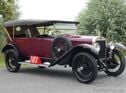
To Be OFFERED AT AUCTION at RM Sothebys' The Monterey Auction event, 13 - 15 August 2026.
$5,000,000 - $6,500,000 USD
- A truly outstanding supercharged six-cylinder Mercedes-Benz
- Extraordinary and unique open coachwork by the revered Saoutchik
- Built for aristocratic sportsman and art collector Oliver de Rivaud, the Comte de la Raffinière
- Formerly prized for 55 years by the renowned enthusiast H. Dieter Holterbosch
- Meticulous, fresh, and well-researched concours restoration in its original color scheme
- Features a remarkable, correct interior, upholstered as-new in reptile hides
- Class award-winner at the 2025 Pebble Beach Concours d’Elegance
- A CCCA Full Classic
Please note that this lot is titled as a 1927,
THE MERCEDES-BENZ TYPE SGermany’s post-World War I depression necessitated a merger between Daimler and Benz, a process that began in 1925 and was formally consummated on 26 June 1926; the joined companies’ product lines, manufacturing, and management were integrated and rationalized. Most importantly, the marques’ competition in racing ended, and the combined companies’ performance development efforts were placed squarely behind the Mercedes, resulting in some of the most exciting, famous, and successful automobiles ever built.
The immediate result of the renewed focus and the concentration of the engineering talents of Dr. Ferdinand Porsche, Hans Nibel, and Fritz Nallinger was the Mercedes-Benz Type S. Developed as a successor to the 6,246-cubic-centimeter Model K, it was an automobile that would forever establish the credentials of Mercedes-Benz at the pinnacle of high-performance luxury automobiles. As the post-war recession faded, it was succeeded by an era of prosperity and a new social freedom, the Jazz Age. The Type S, developed as a successor to the Model K, was vigorous, powerful, vibrant, and purposeful. It became a signature of the times and the pinnacle of aspirations that, in the Roaring Twenties, seemed accessible to all.
Displacing 6,789 cubic centimeters, the all-new Type S engine had larger valves, dual carburetors, a modestly increased compression ratio, and a larger supercharger that delivered 7 psi of boost when engaged. Rated 26/120/180 horsepower, the numbers denoting the engine’s taxable, naturally aspirated, and supercharged horsepower ratings, it owed little more than its single overhead camshaft and six cylinders to the earlier K and its predecessors. The design ingeniously deals with one of the major problems of 1920s automobiles, flexible chassis. For the S, the Mercedes team designed a “unit” engine and transmission with rigid mounts, providing cross-bracing and a jointed torque tube drive to the back axle. The massive powerplant contributed its own rigidity to the chassis structure, which was completely revised.
Fitted with streamlined, lightweight, two- and four-seat open coachwork, it was a sports car for select, successful owners who prized quality, flair, and performance above all else. It also was exclusive, with only 124 Type S and 114 Type SS built.
AN ARISTOCRATIC 680 S BY SAOUTCHIKAccording to a copy of the car’s original
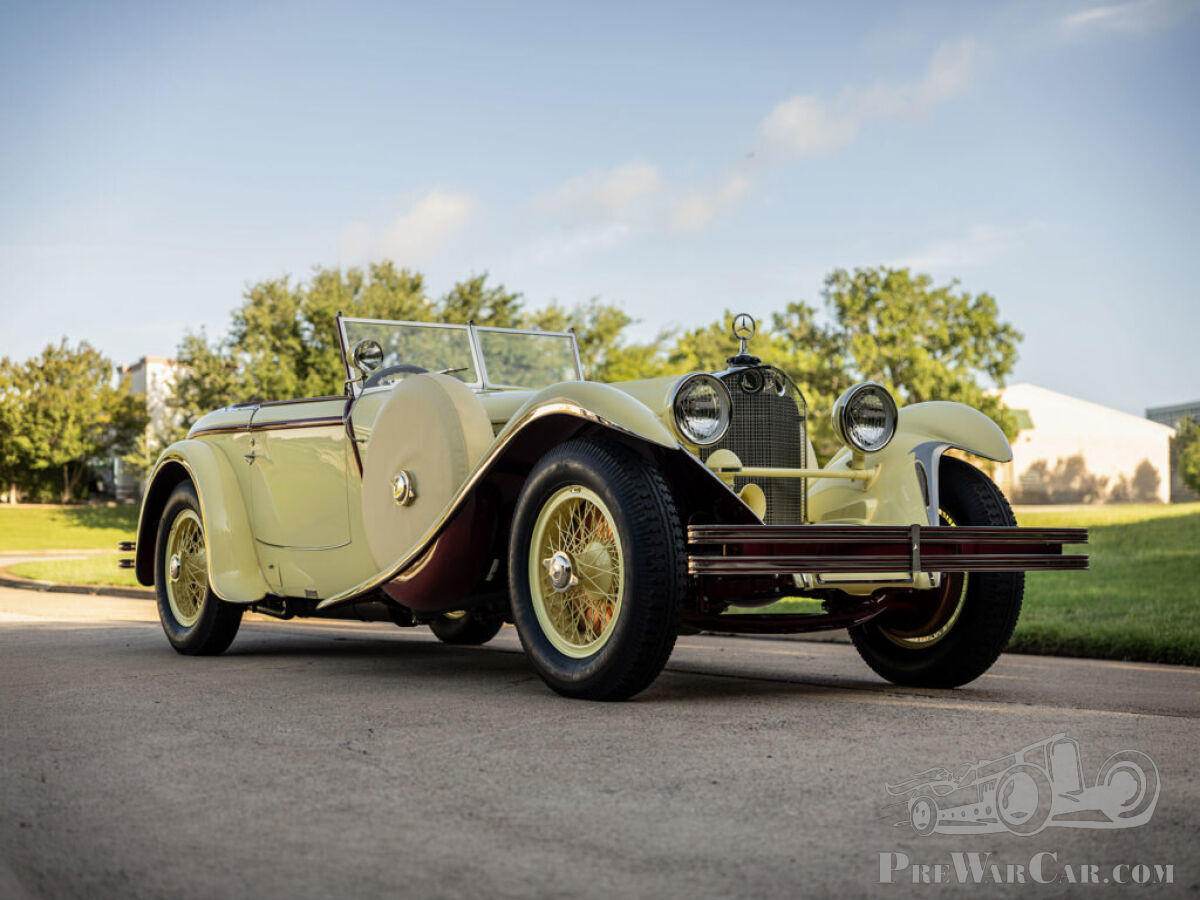
commission paper on file, this 680 S, chassis number 35903, was ordered in July 1928 by Oliver de Rivaud, the Comte de la Raffinière, member of a prominent French banking family as well as a noted breeder of champion racehorses and collector of fine art. The Comte was a devoted client of both Mercedes-Benz and the renowned Parisian coachbuilder Saoutchik, known for dramatically styled designs with an exceptional level of finish; he would later be the original owner of the famous Saoutchik-bodied Bucciali TAV-12, as well as one of the 500 K Autobahnkuriers.
His 680 S was delivered as a four-passenger open tourer, first registered in his name as 3387-X1 on 2 August 1928. Its owner shortly commissioned his favored coachbuilder to mount the car with one of their fabulous, highly detailed and ornate creations, the style described in their catalogue as the Torpedo-Sport “Cannes,” a low four-passenger open car with disappearing top accentuating its svelte, taut lines. This was, significantly, the only car of the “Cannes” type known to have been delivered without roll-up windows. It was shown by its proud owner at the 8th
Salon Anime de la Carrosserie, held at the Park des Princes on 4 June 1929; notably, de Rivaud’s name appears with the car on the published entry list for the event. Photographs of the car at the show appeared in contemporary French magazines, one of which described the car as finished in cream with red moldings and matching leather interior, trimmed in amaranth wood.
The car remained with the Comte until 25 July 1931, when it was registered to Maurice d’Okhuysen of Versailles, who had been raised by the de Rivaud family and served as trainer to the family’s racehorses. Within the year it passed to shoe designer René Eliassabide, inventor of the rubber-soled sandal, then in August of 1934 to another owner in Paris. In June of 1937 it was acquired by Albert Emile Storm de Grave, a member of a prominent Dutch aristocratic family living in Antibes. It is believed to have exported by him to the Netherlands, as indicated by the “Véhicule Dédouané” stamp on copies of the original registration documents, as well as the badge from the Royal Dutch Automobile Club that was affixed to the dashboard. It is believed to have then remained in his ownership until his passing in 1954, and to have soon after been sold from his estate.
AMERICAN LIFELikely through the auspices of an East Coast dealer, the 680 S made its way across the Atlantic, and in the late 1950s was photographed, still in apparently very original condition and carrying its 1937 French registration plate, outside the New York shop of noted foreign car mechanic Herman Ott. Within the year it was photographed by the noted motoring historian and shutterbug Henry Austin Clark Jr., again outside Ott’s but now with a New York registration plate.
Dieter Holterbosch of New York City, the Mercedes-Benz’s new owner, was the American importer for Löwenbräu beer, and led a distinguished career that would eventually see him become the largest distributor of major beer brands on the East Coast. According to his longtime collaborator, restorer Chris Charlton, the 680 S was Mr. Holterbosch’s first acquisition in what eventually became a small, select collection of carefully chosen vintage and sporting automobiles, including extraordinary examples of Duesenberg, Hispano-Suiza, Rolls-Royce, and Mercedes-Benz—notably eventually including, at one time, a second 680 S, as well as an original W154! The cars were quietly housed in an imposing formal building on the Holterbosch estate at Cove Neck, Long Island, and were occasionally exercised on local roads but almost never exhibited at public events during their decades in his ownership. Indeed, following its cosmetic restoration in the 1980s, chassis number 35903 is believed to have been shown only once by Mr. Holterbosch, at Techno Classica Essen in 1994.
When the Holterbosch stable was at last quietly dispersed in 2013, his beloved 680 S was purchased by prominent enthusiast Howard Fafard of Framingham, Massachusetts. After six years, Mr. Fafard in turn sold the car to the present owners, who decided that the car, with its exceptional Saoutchik coachwork and period concours history, would be worthy of a fresh restoration, returning it to its original livery and trim.
Extensive research by historian Jonathan Sierakowski included examining every other surviving Saoutchik body on a 680 S, and delving deeply into the car’s history and its details. Inspection showed that the car remained astonishingly original “in its bones,” including the chassis, engine, and body with its Saoutchik sheet metal, much of its original wood, and all pieces of wood and metal trim bearing body number 1764 (which was even present on the original burlap, covering the seat cushion springs). Areas of original paint were discovered, as was a sample of original red lizard hide from the upholstery. Copies of the exhaustive research, included in the file, show these areas as well as all of the proper stampings throughout, thoroughly verifying the originality of this exceptional 680 S.
With this material in hand, restoration progressed, with the goal being to preserve the wonderful originality and purity of the car’s components, while also using the samples of original finishes to ensure that they would be accurately recreated. No expense was spared to this end; the snippet of upholstery found during disassembly was examined by a herpetologist to ensure that the new interior would utilize the proper, Saoutchik-correct lizard—Asian Water Monitor, as it turned out, as was originally supplied for the interior by the Alpina company. Much of the restoration was completed by Stone Barn of Vienna, New Jersey, with further extensive authenticity work undertaken thereafter by Straight-Eight of Troy, Michigan. Numerous parts and reference materials were provided by the noted supercharged Mercedes authority, Markus Kern.
At completion of the restoration, the 680 S was debuted at the 2025 Pebble Beach Concours d’Elegance, where it was awarded 2nd in class against tremendous competition within an especially well-stocked gathering of pre-war Mercedes-Benzes. Since that auspicious showing, it has remained unexhibited at major events, instead being conserved within the consignor’s esteemed collection, and thus remains fresh and eligible for any number of other major concours and other showings across the United States and, indeed, worldwide.
It is a wonderful example both of the 680 S and of Saoutchik’s superb talents with materials and design—together resulting in a remarkably well-balanced, deeply attractive, muscularly sporting machine that is nearly unrivaled in its era for power and glory.To view this car and others currently consigned to this auction, please visit the RM website at
rmsothebys.com/auctions/mo26/.