Het wereldwijde magazine en verkoopplatform voor liefhebbers van klassieke auto’s, door liefhebbers.
Het wereldwijde magazine en verkoopplatform voor liefhebbers van klassieke auto’s, door liefhebbers.


Filter
Maak een keuze
- Auto's
-
Merk >>
-
Bouwjaar >>
-
-
Categorie >>
- Motorfietsen
- Onderdelen
-
Automerk >>
-
Fabrikant >>
-
Categorie >>
- Fietsen
-
Bouwjaar >>
-
Landen


About what is it? Quiz #470: 1929 Röhr 8 R Sport-Roadster by Autenrieth
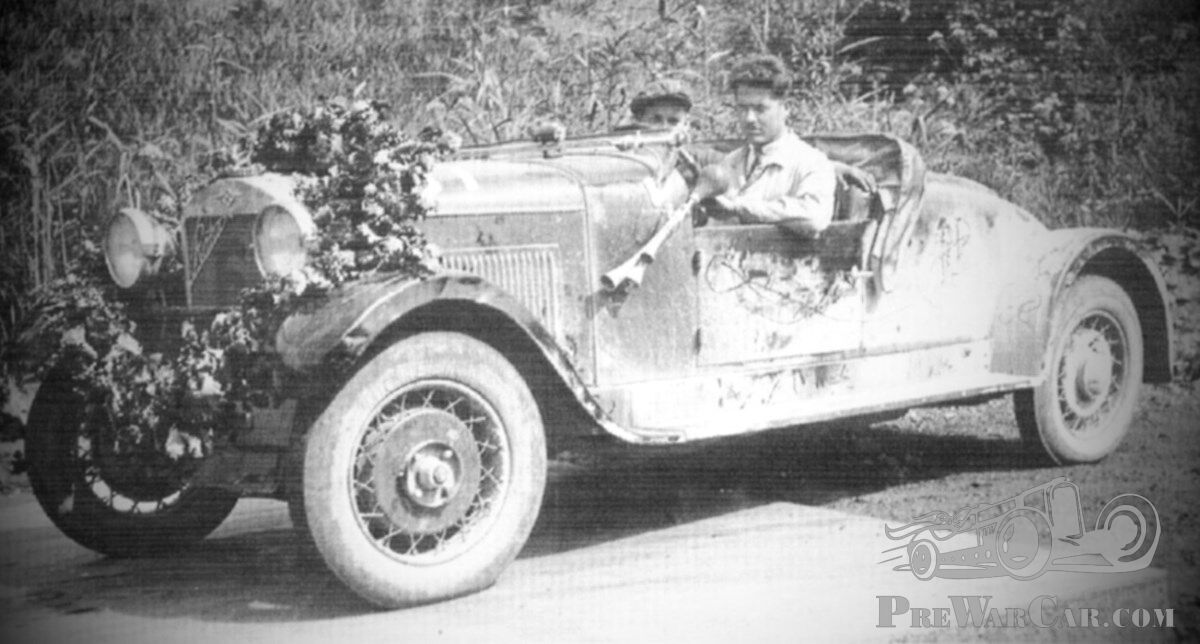

Our last weeks' quiz was not an easy one, but even though five answers arrived and they were all correct. More or less... The autoball-car is a 1929 Röhr 8 R Sport-Roadster, bodied by Autenrieth, like most cars of the Röhr production.
The Röhr Auto AG was founded in 1926 by Hans Gustav Röhr, born in Uerdingen / Rheinland in 1895. Young Hans Gustav invented a modern aeroplane at the age of only 17, using a 600 HP - radial engine, he constructed using five air-cooled motorcycle cylinders.
In World War One, Röhr volunteered for the fighter pilots and afterwards, as a civilian, he moved to Priamus, a manufacturer of car and aircraft engines in Cologne-Sülz. After the war, any activities in aircraft building were forbidden for the German industry and Röhr concentrated on automobiles.
After three prototypes, built in 1919 (for Priamus), in 1921 (after Röhr left Priamus and settled to Berlin) and in 1923, he finally founded his own company, sponsored among others by the entrepreneur family Stinnes in October 1926. The new Röhr Auto AG was located in Ober-Ramstadt (near Darmstadt) and used the old Falcon Automobilwerke buildings. In 1927, the type "R 8/40 PS" was presented. Only one year later, after about 100 produced examples, the car was modified because of disappointing power, high consumption of fuel, as well as oil and resonance vibrations, depending on the engine revs. It was replaced by the modernized "8 Typ R 9/50 PS". And this type is the one, we searched for in our quiz. As the 40 HP car featured a very modern chassis with a stunning roadability, the upgrades of the type 8 R concentrated on the engine. The capacity rose from 2 litres to 2.3 litres and the car was now able to reach a 100 km/h top speed. But even if the car was competitive now, the sales still were disappointing.
Till 1930 Röhr wasn´t able to sell more than around 1000 cars. In 1930 a very new engine was presented: A narrow-angle (10°) 2,5 litre V8 with an output of 55 HP. The body was longer and wider now, resulting in a plus of more than 300 kg. Still, the sales didn´t rose and in 1931 Hans Gustav Röhr had to file for bankruptcy. Röhr himself had to leave the company, but the Swiss Röhr general agent Joos Andreas Heintzthen founded the "Neue Röhr AG" and continued to build the car until 1933, but no more than 350 examples were produced.
The new owner commissioned Ferdinand Porsche to construct a completely new car. Porsche used already finished construction documents from an order of Wanderer and in 1933, the new Röhr 8 Type F 13/75 HP was presented. With again increased dimensions, the car offered a 3,3-liter engine with 75 HP and finally reached the driving performance, which one expected from an eight-cylinder car. Nevertheless, until 1934 only 250 cars were delivered. An even stronger version, the supercharged Olympier Typ FK 13/75/100 PS followed, but this very expensive car was built in only 20 units. The last car of the dying breed was the Röhr Junior, a licensed version of the Tatra 75. The doors closed in 1935 and all production documents and tools were offered for sale. The Stoewer company secured the production rights of the Röhr Junior and built it as Stoewer Greif Junior until 1939. But what happened to Hans Gustav Röhr after leaving his factory in 1931? Röhr found a new employment at Adler, where he constructed the Trumpf, the Standard 6, the Favorit and others. In 1935 he changed to Daimler-Benz but in 1937, at the age of just 42 years, he died of pneumonia.
As mentioned above, we have five correct answers for this weeks quiz and it´s very hard for me, to decide who is the winner. "Record" sent a short, but correct one sentence answer. Gerd Klioba is the only one with the very correct type, as he added the "Sport" to the roadster, but sorry, you are wrong with the swing-axle. You wrote, that the Röhr was the first German car featuring this type of axle, but Edmund Rumpler already used a swing axle at his Tropfenwagen in 1921. Fried Stol is telling us very good information about the three prototypes, but the car we have been searching for is not the 1927 type "8", but the successor, the type "8 R". A VERY good answer also came from Fritz Hegemann. Many correct details about the engine and the roadability are given. But the dot on the i came from Michael Schlenger, as he recognised the driver of the autoball-car: the son of Georg Autenrieth whos coach build-factory built the body of our quiz-car. Congratulations Michael, for winning this weeks quiz!
The current top 5 of the six-month competion, sponsored by Hans Compter Rare Cars:
1. Gerd Klioba
2. Frits Hegemann
3. Fried Stol
4. Henk Visscher
5. Alan Spencer
Words and photograph by Hubertus Hansmann.
Gepubliceerd:
zaterdag mei 26th, 2018
Facebook
LinkedIn
Twitter
WhatsApp
Email
Copy
Reacties
Hubertus Hansmann
27 Mei 2018, 12:25
Thank you Michael! I also wondered about the 600 HP output, but I nowhere found another description. And thanks for mentioning Joseph Dauben. As far, as I know, he built the very first plane together with him and afterwards Röhr and Dauben worked together at Priamus, at the Röhr AG, working for Adler and at Daimler-Benz, until Röhrs early death in 1937.
Lees verder
Michael Schlenger
26 Mei 2018, 12:14
Excellent account of Hans Gustav Röhr's achievements as a more or less self-taught "engineer" (actually the serious work used to be done by his life-long companion Joseph Dauben).
Just one remark: I doubt that the engine young Hans Gustav used for his first plane in 1912 had an output of 600 h.p. - it should rather say 60 h.p., probably. According to Werner Schollenberger's brilliant book "Röhr - Ein Kapitel deutscher Automobilgeschichte", the very engine was provided by the Rheinische Aerowerke in Düsseldorf and not constructed by Röhr/Dauben.
Lees verder
Just one remark: I doubt that the engine young Hans Gustav used for his first plane in 1912 had an output of 600 h.p. - it should rather say 60 h.p., probably. According to Werner Schollenberger's brilliant book "Röhr - Ein Kapitel deutscher Automobilgeschichte", the very engine was provided by the Rheinische Aerowerke in Düsseldorf and not constructed by Röhr/Dauben.