Het wereldwijde magazine en verkoopplatform voor liefhebbers van klassieke auto’s, door liefhebbers.
Het wereldwijde magazine en verkoopplatform voor liefhebbers van klassieke auto’s, door liefhebbers.


Maak een keuze
- Auto's
-
Merk >>
-
Bouwjaar >>
-
-
Categorie >>
- Motorfietsen
- Onderdelen
-
Automerk >>
-
Fabrikant >>
-
Categorie >>
- Fietsen
-
Bouwjaar >>
-
Landen


De verkoopomgeving: alle vooroorlogse auto's te koop
Overzicht van gerelateerde advertenties 1907 Premier Model 24
-

1915 Ford Model T Coupelet | Estate of Mark Smith Auction | Gooding & Company | April 7, 2023
From its October 1908 introduction, Henry Ford’s Model T completely revolutionized automobile design, production, and its maker. An uncanny combination of durability, reliability, and affordability, the Model T remained in production for nearly 19 full years with some 15 million examples of the beloved “Tin Lizzie” built. Visually similar to the..1915FordModel T CoupeletVERKOCHT -
1905 REO Five-Passenger Detachable Tonneau | Estate of Mark Smith Auction | Gooding & Company | April 7, 2023
Ransom E. Olds may have left Olds Motor Works in January 1904, following a dispute with controlling shareholders who sought an end to Curved-Dash Runabout production, but he triumphantly re-emerged with his new REO marque that summer. Riding an 88" wheelbase chassis, this two-cylinder, 16 hp Five-Passenger Detachable Tonneau marks the top of the..1905REOFive-Passenger Detachable TonneauVERKOCHTLocatie: Verenigde Staten -
1907 Packard Model 30 Town Car | Estate of Mark Smith Auction | Gooding & Company | April 7, 2023
By the time Packard’s Model 30 was introduced for the 1907 model year, the company had built its reputation for producing automobiles of the highest quality and performance, with highly publicized endurance and speed records. Its most successful model to date, the Model 30 remained Packard’s flagship offering for six model years, with most recei..1907PackardModel 30 Town CarVERKOCHT -
1916 Pierce-Arrow Model 38 C-4 Five-Passenger Touring | Estate of Mark Smith Auction | Gooding & Company | April 7, 2023
Pierce-Arrow was one of “The Three Ps” of American motoring; along with Packard and Peerless, they were considered among the finest American-made automobiles of the early 20th century. Built without regard to expense, Pierce-Arrows were aimed at an elite clientele and renowned for their exceptional build quality. A 1916 advertisement from the Sa..1916Model 38 C-4 Five-Passenger TouringVERKOCHT -
1910 Cadillac Model 30 Four-Passenger Demi-Tonneau | Estate of Mark Smith Auction | Gooding & Company | April 7, 2023
Having become a division of General Motors in July 1909, Cadillac was one of the first manufacturers to achieve true standardization of replacement parts throughout a model year, which greatly enhanced the value and notoriety of the brand. The sole model from Cadillac in 1910 was the Model 30, which saw 8,008 units built in a variety of open and..1910CadillacModel 30 Four-Passenger Demi-TonneauVERKOCHT -
1917 Ford Model T Town Car | Estate of Mark Smith Auction | Gooding & Company | April 7, 2023
Building upon the succession of updates and improvements applied to Ford’s wildly successful Model T since its introduction, changes for 1916–1917 most visibly included a change to a black radiator-shell finish, new rounded fenders, and a revised hood design. Formerly brass-finished components now sported nickel plating. Catalogued since 1909, t..1917FordModel T Town CarVERKOCHT -
1907 Ford Model K Touring | Estate of Mark Smith Auction | Gooding & Company | April 7, 2023
Progressing beyond the light and relatively affordable, two-cylinder Model A of 1903–1904, the fledgling Ford Motor Company soon offered several four-cylinder models and by late 1905, the range-topping, six-cylinder Model K. While Henry Ford was primarily focused on his concept for an inexpensive “people’s car,” which would soon manifest as the ..1907FordModel K TouringVERKOCHT -
1916 Packard Twin Six 1-25 Seven-Passenger Touring | Estate of Mark Smith Auction | Gooding & Company | April 7, 2023
Upon the introduction of the Twin Six in mid-1915, Henry Joy, president of Packard Motor Car Company proclaimed it to be “the greatest piece of machinery that ever went upon the highways.” Fast, smooth and powerful, even at extremely low rpm, the Twin Six was an unbridled success, outselling competitor’s finest offerings by a wide margin. The in..1916PackardTwin Six 1-25 Seven-Passenger TouringVERKOCHT -
1917 Pierce-Arrow Model 38 C-4 Open-Front French Brougham | Estate of Mark Smith Auction | Gooding & Company | April 7, 2023
Both to retain its high standards and to facilitate its continuing innovation and refinement, Pierce-Arrow closely controlled all aspects of automobile construction, including coachwork, for which most other luxury marques relied on outside coachbuilders. Instead, Pierce-Arrow worked with its Buffalo, New York neighbor, Aluminum Company of Ameri..1917Model 38 C-4 Open-Front French BroughamVERKOCHT -
1910 White Model GA Coupe | Estate of Mark Smith Auction | Gooding & Company | April 7, 2023
In the early days of motoring, White was known as perhaps the highest quality steam car in the world, and even President William H. Taft owned one. But by 1910, the internal combustion engine had become the favored type of propulsion and White debuted its GA model. This Model GA is an outstanding example, a very rare coupe that was previ..1910WhiteModel GA CoupeVERKOCHT


Uitgelicht
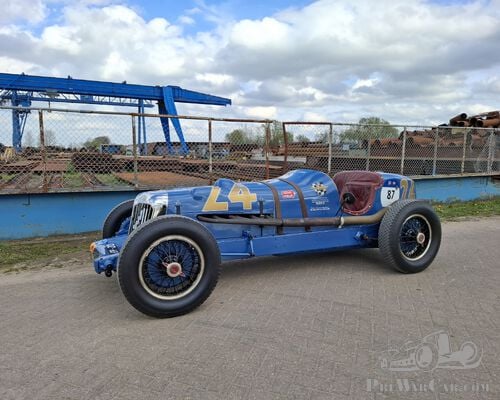
1932 - Graham " Lucenti " Indianapolis
Original participant of the 1932, 1934 and 1935 Indy 500. Best result: finishing 10th overall in the 1934 Indy 500 with driver “Herb” Ardinger...
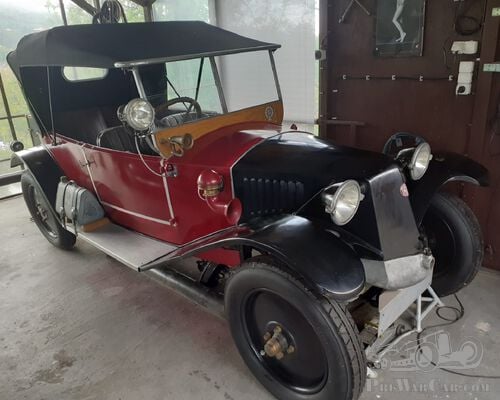
1924 Tatra 11 Roadster – Authentic Survivor with Running Boxer Engine | Rare Opportunity for Discerning Pre-War Collectors

wanted 1923 Peugeot 163 br worm drive differential and torque tube
Hi, I'm looking to buy a worm drive differential and torque tube for a 1923 Peugeot 163 br also a windscreen frame, my car is a roadster cabriolet..