Het wereldwijde magazine en verkoopplatform voor liefhebbers van klassieke auto’s, door liefhebbers.
Het wereldwijde magazine en verkoopplatform voor liefhebbers van klassieke auto’s, door liefhebbers.


De verkoopomgeving: alle vooroorlogse auto's te koop
Overzicht van gerelateerde advertenties Studebaker Comander
-

1926 Morgan-Monotrace TMX Torpédo | Selections from the Mullin Collection Auction | Gooding & Company | April 26, 2024
Built from 1924 through 1928, the Morgan-Monotrace filled a perceived niche in the market between a sidecar motorcycle and an automobile. The original design was created by Mauser in Germany but licensed for production by Monotrace in St. Etienne, France. Its nickname, the “single track motorcar,” hints at its purpose as its two-wheeled design a.. -
1923 Citroen Type C 5 HP Torpédo | Selections from the Mullin Collection Auction | Gooding & Company | April 26, 2024
Debuted at the October 1921 Paris Motor Show as the Type C, the Citroën 5 HP (“5CV” from 1925) was engineered by Edmond Moyet as a smaller and even more affordable companion to the Type A. Powered by an economical 856 cc inline four-cylinder engine, the 5CV was well-equipped despite its value price, including standard electric starting and light.. -
1928 Avions Voisin Type C14 Chartreuse Berline | Selections from the Mullin Collection Auction | Gooding & Company | April 26, 2024
Having founded the world’s first aviation company in 1906, with his younger brother Charles, the pioneering Gabriel Voisin would go on to build over 3,500 military aircraft for France and other countries through WWI. After subsequent exploits in prefab building and aircraft-hangar production, he then founded Avions Voisin, which became one of th.. -
1928 Avions Voisin Type C28 Recreation | Selections from the Mullin Collection Auction | Gooding & Company | April 26, 2024
This evocation of a Voisin Type C28 was created as a movie prop for use in the filming of Sahara, a 2005 movie starring Matthew McConaughey and Penélope Cruz. Based on a novel by best-selling author Clive Cussler, the film was a continuation of his Dirk Pitt action stories. Cussler was a noted car enthusiast and it is believed that his .. -
1924 Delage GL Skiff | Selections from the Mullin Collection Auction | Gooding & Company | April 26, 2024
The Delage GL, or Grande Luxe, was designed in 1923 to garner a share of the high-end luxury market dominated by marques like Rolls-Royce and Hispano-Suiza. Fitted with an advanced X- member chassis and a powerful overhead-valve inline six-cylinder engine, the GL was built in a very small number with only approximately 180 chassis being manufact.. -
1930 Citroen C4 Limousine | Selections from the Mullin Collection Auction | Gooding & Company | April 26, 2024
Debuted at the 1928 Paris Motor Show, the four-cylinder Citroën AC4 and six-cylinder AC6 were methodically improved evolutions of the French automaker’s prior B12, B14, and B15 model lines. A slight redesignation came by 1929, with the AC (André Citroën) model prefix simplified to C4 and C6. Featuring handsome styling clearly inspired by Ford’s .. -
1928 Citroen B14 Coupe | Selections from the Mullin Collection Auction | Gooding & Company | April 26, 2024
Featuring an all-new and lighter-weight chassis and all-steel bodywork, the B14 continued to improve Citroën’s characteristically advanced and effective engineering principles with a smoother-running engine and new four-wheel brakes. Initially powered by a 1,539 cc four-cylinder powerplant, subsequently upsized to 1,628 cc, the B14 was offered i.. -
1928 Tracta D2 9CV Faux Cabriolet | Selections from the Mullin Collection Auction | Gooding & Company | April 26, 2024
A boutique manufacturer, Tracta was founded by Jean Albert Grégoire in 1926, and its initial models were geared towards competition – even winning its class at the 24 Hours of Le Mans in 1927. Grégoire developed the “Tracta joint,” which allowed the front wheels of a car to be driven while still steering, a predecessor of the CV joints that are .. -
1927 De Dion-Bouton Type TKS Torpédo | Selections from the Mullin Collection Auction | Gooding & Company | April 26, 2024
Jules-Albert de Dion set out to manufacture steam cars late in the 19th century in the town of Puteaux, a suburb of Paris. He partnered with Georges Bouton and Charles Trépardoux to form De Dion-Bouton in 1883. Together the trio revolutionized the automotive industry with new technologies such as a modern rear axle design, V-8 engine, and rack a.. -
1930 Darmont Morgan Sport Aero Roadster | Selections from the Mullin Collection Auction | Gooding & Company | April 26, 2024
As early as 1913, the jaunty three-wheeled Morgan had become very popular in France; spurred by a local hero winning a Cyclecar Grand Prix race in one such Morgan at Amiens that year. Following WWI, another victory in a Morgan by a Frenchman, this time at the Circuit de l’Eure, increased their popularity with fans of the sport yet again. Afforda..


Uitgelicht
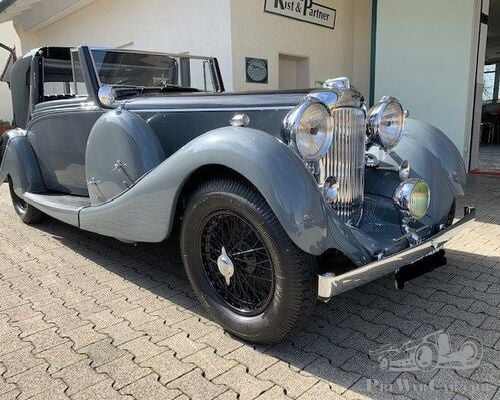
Lagonda LG 45 Coupe de Ville Sedanca van Mayfair
Als opvolger van de M45 werd de LG45 gebouwd rond dezelfde uiterst capabele, in de competitie beproefde 4,5-liter Meadows-zescilinder-in-lijn, maar..
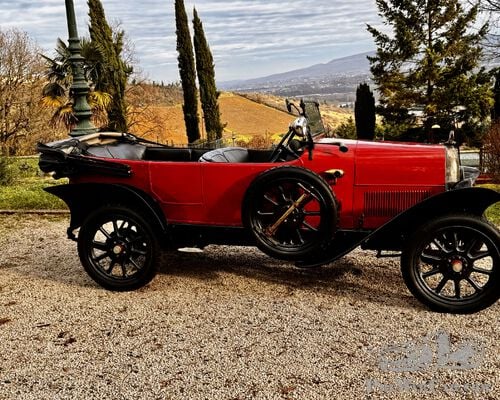
1923 Fiat 501S torpedo sport
Officieel geregistreerd als authentiek voertuig in het Historisch Fiat Register in Turijn.Zeer verzorgd exemplaar, circa 20 jaar geleden opn..
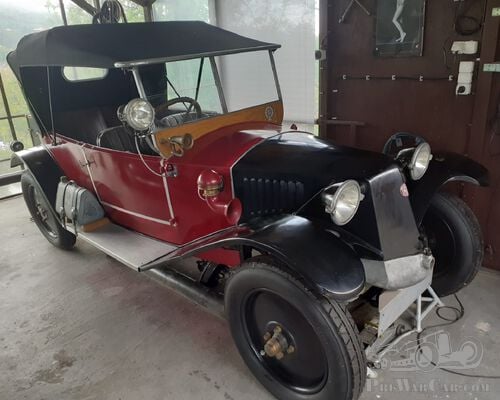
1924 Tatra 11 Roadster
Een uitzonderlijk stuk autogeschiedenisTe koop aangeboden: een bijzonder zeldzame Tatra 11 Roadster uit 1924, één van de belan..