Het wereldwijde magazine en verkoopplatform voor liefhebbers van klassieke auto’s, door liefhebbers.
Het wereldwijde magazine en verkoopplatform voor liefhebbers van klassieke auto’s, door liefhebbers.


Filter
Maak een keuze
- Auto's
-
Merk >>
-
Bouwjaar >>
-
-
Categorie >>
- Motorfietsen
- Onderdelen
-
Automerk >>
-
Fabrikant >>
-
Categorie >>
- Fietsen
-
Bouwjaar >>
-
Landen


Freight wagons and automobiles at 153 Mile House
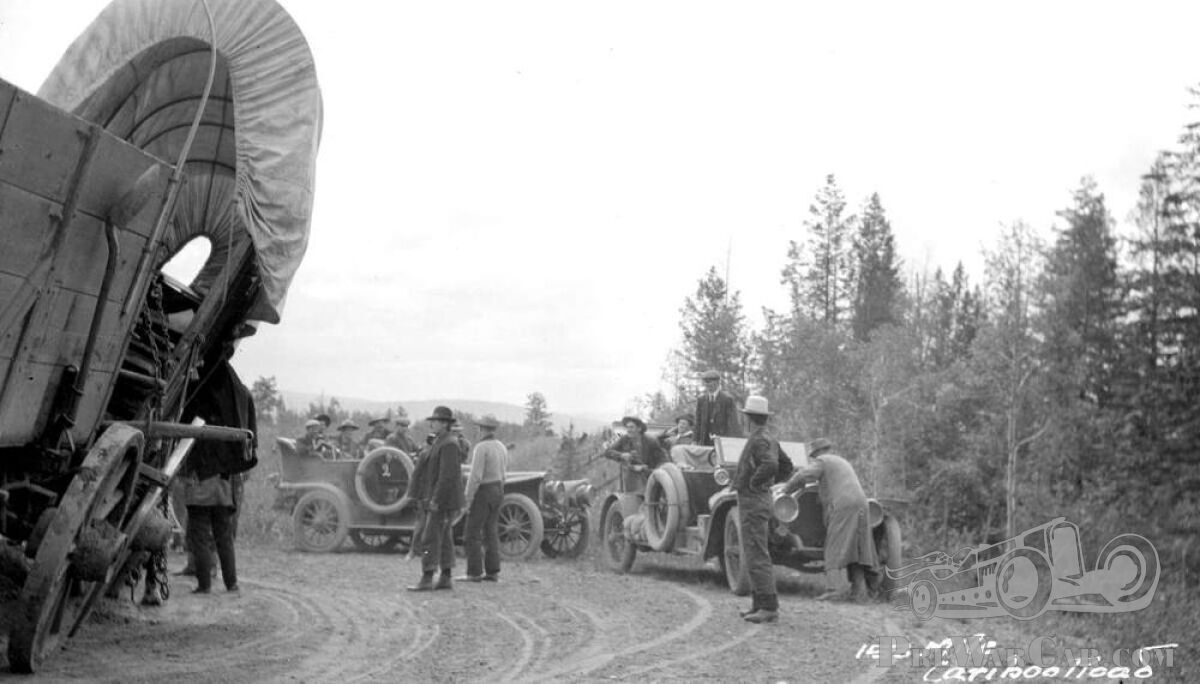

Earlier this week in our Monday Mystery we already published an article with a photograph taken in the Cariboo region in British Columbia, Canada. To be more precise in Stanley.
Today’s photograph is taken in 1910 by Frank Cyril Swannell in the same area. The Cariboo region had a major gold rush in the early 1860's and is still being mined now.
We see Cariboo Wagon Road at 153 Mile House. 153 Mile House is a small 2-story building (not feasible in the photograph) constructed by Louis Crosina and his wife Clara Noble Crosina. After completion, Louis opened a shop to pay the workmen who helped him build the house, in goods as requested by the men. Later he would also start a blacksmithing service, which became a very successful business. Although 153 Mile House was not a stagecoach stopping place, it was known to be a stopping place for teamsters.
Both the shop and the blacksmith business continuously operated for over 35 years. And became so successful that by 1914 a new store was built across the road to expand. This store was run until 1963 by one of their daughters Lilly. In the meantime, the property changed ownership and became in the possession of the family Patenaude. They decided to turn 153 Mile House into a private museum, which can still be visited today.
That was a short history lesson. Now back to the photograph. The two large pre-war cars we see stopped at 153 Mile House. Who can tell us more about the cars we see? Please comment below.
Words by the editor. Photograph sent in by Steve Diggins. Source: BC Archives.
Gepubliceerd:
zondag september 2nd, 2018
Facebook
LinkedIn
Twitter
WhatsApp
Email
Copy
Reacties
Steve Diggins
06 September 2018, 01:03
If you go to the BC Archives web site, find the 'search archives 'page and put A-05331 in the search box you will find a picture of the Sheffield Simplex. Click on the image to make it larger. This was one of the first cars on that road, if not the first. There is a two horse open phaeton behind the car and a freight wagon. It seems the horse drawn vehicles have stopped to get a better look at this new thing called an automobile.
Lees verder
Steve Diggins
05 September 2018, 00:35
Sorry , another mistake. It is a Sheffield -Simplex.
Lees verder
Steve Diggins
04 September 2018, 02:55
Yes. I think the first car is a Coventry Simplex. There were at least two of these brought into BC, this one and one with wood spoke wheels, The second car is 1908 6 cylinder Winton 16, The men are a survey team going to a remote area of northern BC, This was a vast pristine wilderness few European eyes had seen, Cyril Swannell was the lead surveyor and lucky for us an avid photographer.
Lees verder
Ariejan Bos
04 September 2018, 17:18
Steve, I agree with you about the Winton. Fits clearly better, but apparently you have more information on the background of this photo.
Lees verder
Ariejan Bos
02 September 2018, 13:28
Canada makes car identification more complex, with cars being imported from the US, UK and France and then of course not to forget their own products like the Russell and the McLaughlin. In this case the first car seems to be a 1909 or 1910 Sheffield-Simplex. The round radiator is not really clear, but despite the blurry image the make's symbol seems to be just visible on the radiator core. The low appearance together with the characteristic front mudguards, the wire wheels and other details confirm this id. The other car is more of a challenge, but the rather unique shape of the front fenders (indeed US!) seems to point at a Stoddard-Dayton, probably an earlier model of 1907 or 1908.
Lees verder