Het wereldwijde magazine en verkoopplatform voor liefhebbers van klassieke auto’s, door liefhebbers.
Het wereldwijde magazine en verkoopplatform voor liefhebbers van klassieke auto’s, door liefhebbers.


Filter
Maak een keuze
- Auto's
-
Merk >>
-
Bouwjaar >>
-
-
Categorie >>
- Motorfietsen
- Onderdelen
-
Automerk >>
-
Fabrikant >>
-
Categorie >>
- Fietsen
-
Bouwjaar >>
-
Landen


Introductie van de auto in Oostenrijk-Hongarije

Hatschek pictured with his Velo in 1895

The 1893 photograph of Zardetti aboard his 4hp Benz Viktoria

The three-wheeled Patent-Motor-Wagen illustrated in the 1893 Benz catalogue
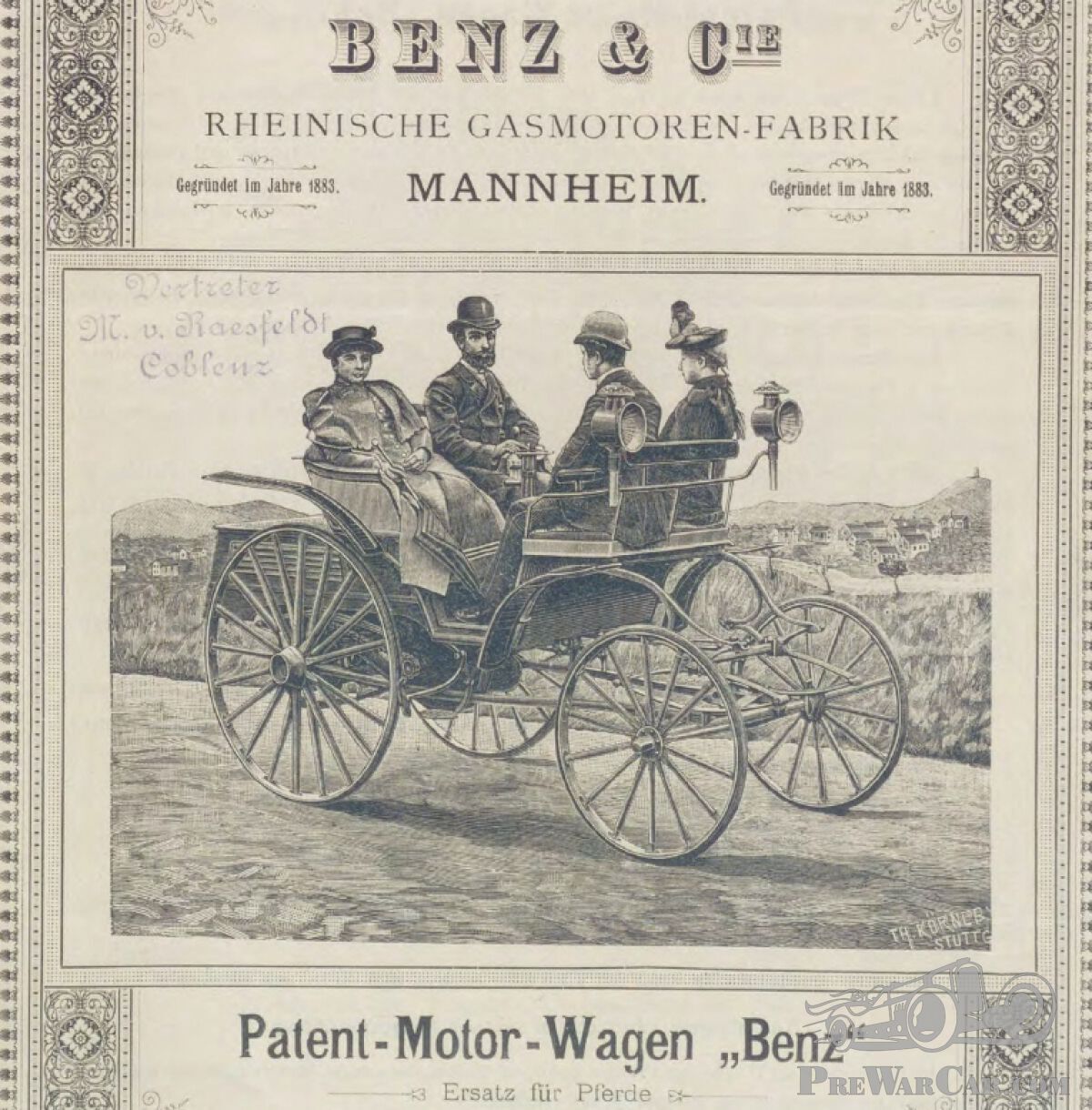
The catalogue also shows a four-wheeled Benz Viktoria similar to Zardetti's
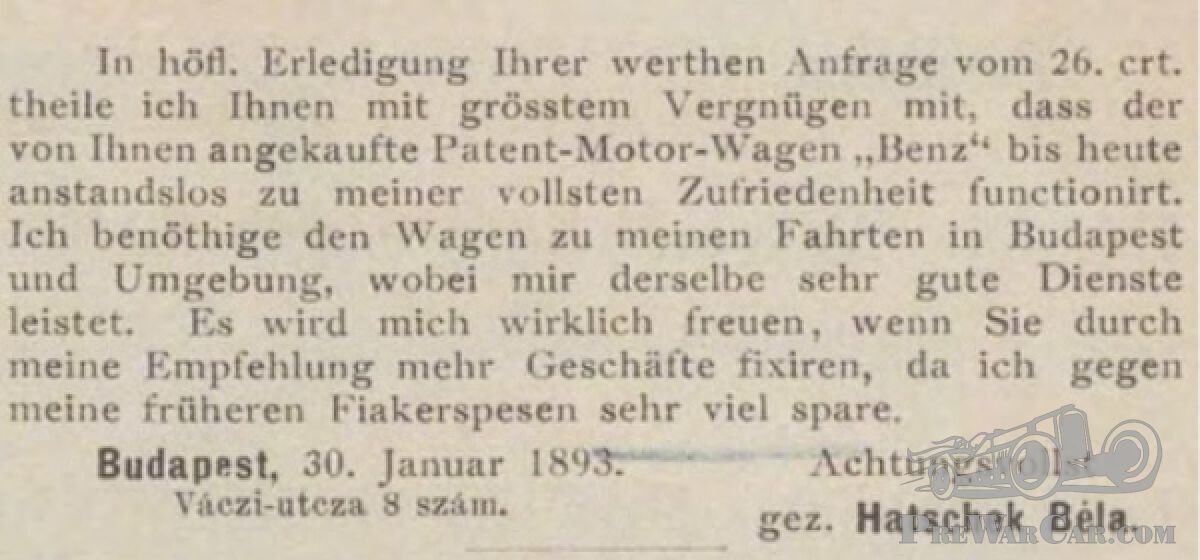
Hatschek's glowing review of his Benz as it appeared in the marketing catalogue


We weten niet hoeveel onze Oostenrijkse en Hongaarse lezers weten over het automobielverleden van hun respectieve landen, maar de meeste mensen zullen er weinig over weten, behalve dat aartshertog Franz Ferdinand werd vermoord terwijl hij in een Gräf & Stift reisde. Wij weten natuurlijk iets meer en kunnen denken aan Austro-Daimler en Lohner-Porsche, waarvan de oorsprong teruggaat tot 1898.
We hadden u niet kunnen vertellen wat de eerste auto was die ooit in Oostenrijk-Hongarije verscheen, maar het is niet meer dan logisch dat het een Benz was, en zo blijkt het ook. Historici hebben jarenlang een artikel van de Allgemeine Automobil Zeitung uit 1911 geaccepteerd, getiteld "De oudste auto in Oostenrijk-Hongarije", waarin werd geconcludeerd dat het een Benz was die in maart 1893 was gekocht door Eugen von Zardetti, een Zwitserse schilder die toen in Oostenrijk woonde.
Zo stond het "feit" 111 jaar lang vast, totdat Dr. Christian Klösch, onderzoeker aan het Weense Museum voor Wetenschap en Technologie, vorig jaar in de bibliotheek op een interessant document stuitte. In een editie van het Neuen Wiener Abendblatt van 3 november 1892 ontdekte hij een passage over "de eerste autorit met een koets zonder paarden", waarin de baanbrekende automobilist Julius Jalowetz werd genoemd, een Weense chemicus die helemaal naar Mannheim was gereisd om zijn auto rechtstreeks van Karl Benz te kopen. Toen Klösch meer informatie zocht, verstrekte Mercedes-Benz hem behulpzaam een exemplaar van een brochure uit begin 1893 waarin de Benz Patent-Motor-Wagen door Jalowetz werd geprezen.
De brochure bevatte ook een recensie van Béla Hatschek, een opticien in Boedapest die later een maker van glazen ogen zou worden. De recensie van Hatschek, gedateerd 30 januari 1893, luidde: "Met groot genoegen deel ik u mee dat de door mij gekochte "Benz" Patent-Motor-Wagen tot op heden tot mijn volle tevredenheid vlekkeloos werkt. Ik heb de auto nodig voor mijn reizen in Boedapest en omgeving, en hij voldoet uitstekend. Het zal mij een waar genoegen zijn als u door mijn aanbeveling meer opdrachten krijgt, want ik bespaar veel op mijn vroegere Fiaker-kosten."
Met deze nieuwe aanwijzing spitte Klösch verder en ontdekte uiteindelijk in het stadsarchief van Boedapest dat Hatschek op 26 november 1892 een vergunning voor het gebruik van een auto had gekregen. De naam van Hatschek was overigens niet onbekend bij autohistorici. In 1895 publiceerde de Koninklijke Automobielclub van Hongarije in haar jubileumjaarboek een foto van hem aan boord van zijn nieuwe Benz Velo.
Ziehier een belangrijke ontdekking die hopelijk de belangstelling voor de vroege paardloze rijtuigen in Oostenrijk en Hongarije zal aanwakkeren. Als u in één van deze landen woont en eigenaar bent van een Victoriaanse auto, waarom ontmoet u dan geen gelijkgestemde liefhebbers en organiseert u geen rally om de baanbrekende inspanningen van Jalowetz en Hatschek te herdenken?
Woorden: Zack Stiling; foto's: CE Auto Classic
Gepubliceerd:
maandag mei 1st, 2023
Facebook
LinkedIn
Twitter
WhatsApp
Email
Copy
Reacties
Robert Simons
12 Juni, 16:36
Horváth Ferenc
17 Mei 2023, 10:07
I am reporting from Hungary. Yes, we know the story of the optician Béla Hatschek with the first Budapest car.
There are almost no vehicles from the time of Kaiser Franz Josef I. in Hungary, even the museum examples were destroyed during the Second World War and the rest became victims of the politics of the 1950s.
Therefore we can't organize a road run to commemorate the pioneering efforts of Jalowetz and Hatschek. :o/
Lees verder
There are almost no vehicles from the time of Kaiser Franz Josef I. in Hungary, even the museum examples were destroyed during the Second World War and the rest became victims of the politics of the 1950s.
Therefore we can't organize a road run to commemorate the pioneering efforts of Jalowetz and Hatschek. :o/
Michael Schlenger
01 Mei 2023, 09:12
It's a mystery to me why the author of this article doesn't mention the "Marcus-Wagen" from 1888/89 as "the first car ever to appear in Austria-Hungary". It had its flaws, wasn't particularly powerful and remained a prototype. Yet, it was without doubt an automobile with a four-stroke petrol engine and even the first one using a magneto-operated ignition. The best thing is: it still exists in running condition!
Lees verder
Jeff Perkins
01 Mei 2023, 04:32
Great story… thank you Mr. Stiling for this and the other excellent articles you write!
Lees verder
Lars Legaard
02 Mei 2023, 13:08
I totally agree, regarding Mr. Marcus. But as most old car people know, due to the fact that he had Jewish origins, the Nazis wanted the car being invented by Mr. Benz, and it is fantastic that the car could be kept hidden during WWll, but as far I know most of the Marcus archives were destroyed by orders from Himmler
The lesson is: You can never twist history!
Lees verder
The lesson is: You can never twist history!
Michael Schlenger
03 Mei 2023, 00:18
I don't know or care what the National Socialists wanted some 80 years ago. I simply expect that a plain fact which is easily available today is taken into account, in particular if an author boasts that he knows "of course" more than the ordinary prewar enthusiast. I am pretty sure that the "Marcus car" is something the veteran car aficionados in Austria are pretty proud of - and rightfully so.
Lees verder
Pal Negyesi
26 Augustus 2024, 08:58
The Marcus car is not part of this story and the reason for that is very simple. Both Dr Klösch who did the initial research and I, who did the research in Hungary, were focusing on imports. Yes, the Marcus vehicle was around—we are perfectly aware of this fact (Dr Klösch works at the Technisches Museum where the Marcus vehicle resides). The fact remains: Siegfried Marcus tinkered with his engine-powered device, but nothing came out of his experiments. Then in 1900 his prototype was dragged onto the "stage" and paraded as the first car built before Benz/Daimler in 1875. This enduring myth elevated the significance of his efforts. Just to explain further: Carl Benz did not invent the petrol-engined car, but he was the first to a) construct an automobile (not a motorized handcart, carriage or any other device but a well-thought out and patented transportation device) b) which became commercially successful. Siegfried Marcus and a lot of others before and after him (Hammel car anyone?) built motorised devices. So when we look at the first car in the Austro-Hungarian Monarchy we study whether Daimler, Benz, Peugeot, Panhard, etc. arrived first.
Lees verder
I'd be fascinated to see more of the 1893 brochure which is mentioned. Is it available anywhere?