Het wereldwijde magazine en verkoopplatform voor liefhebbers van klassieke auto’s, door liefhebbers.
Het wereldwijde magazine en verkoopplatform voor liefhebbers van klassieke auto’s, door liefhebbers.


Filter
Maak een keuze
- Auto's
-
Merk >>
-
Bouwjaar >>
-
-
Categorie >>
- Motorfietsen
- Onderdelen
-
Automerk >>
-
Fabrikant >>
-
Categorie >>
- Fietsen
-
Bouwjaar >>
-
Landen


Sportieve stations wagen: los dit leuke roadster-mysterie uit Leipzig op
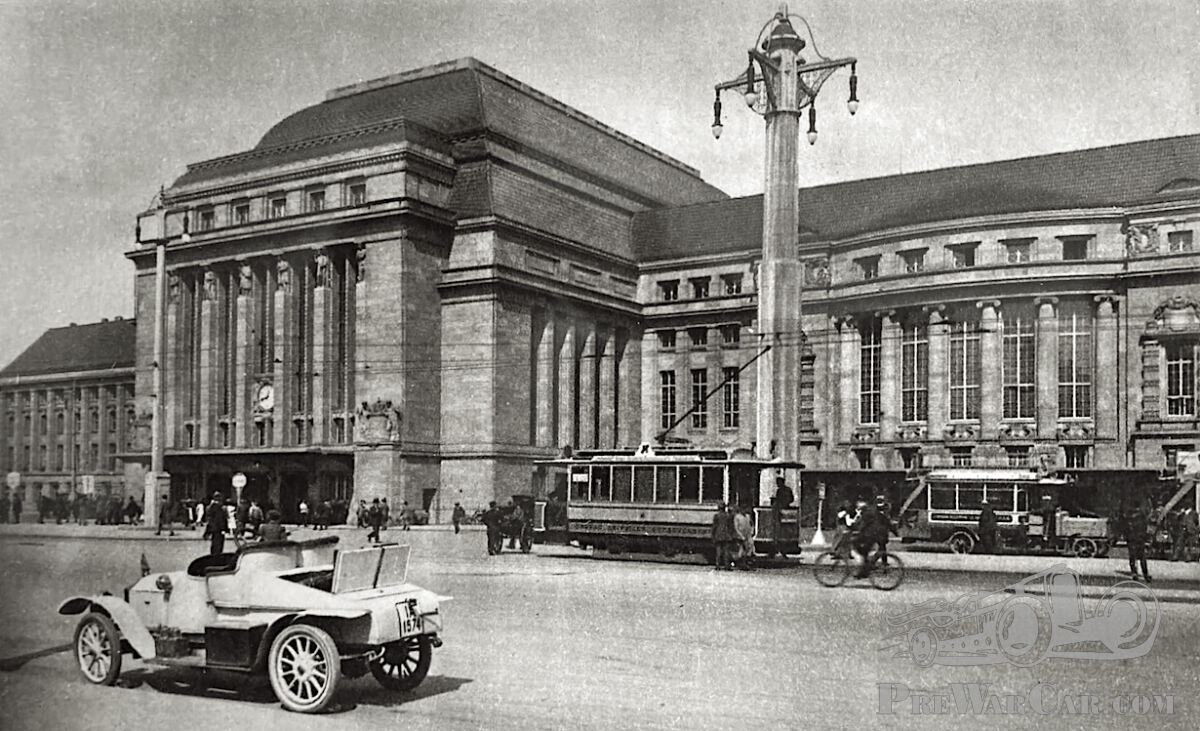

Dit is het Hauptbahnhof in Leipzig - het belangrijkste treinstation van de stad - in zijn volle pracht en glorie. Waarschijnlijk dateert de foto nog uit de begintijd van het station. Het 860.000 vierkante meter grote gebouw opende zijn deuren in 1915 met drie uitgestrekte verdiepingen, waardoor er ruimte was voor meer dan alleen treinsporen en perrons. Let ook op de kolossale lantaarnpaal.
We zijn hier niet om je te vertellen over de architectuur of de boetiekjes en restaurants die nog steeds binnen te vinden zijn. Hoewel we geïnteresseerd zijn in stoomtreinen is het ook niet ons doel om daarover te schrijven. Er is trouwens sowieso geen trein te zien, maar we zien wel een verscheidenheid aan ander vervoer: een tram, een omnibus, een fiets en, heel prominent, een auto. Wat we graag willen weten is wat voor een mooie auto dat is? De nummerplaat IA 1574 suggereert dat hij geregistreerd stond in Berlijn, zo'n 200 kilometer ten noorden van Leipzig. De dickey zitting suggereert dat hij werd gebruikt om meer dan één persoon naar het station te vervoeren. Parkeren was in ieder geval niet zo'n probleem!
Na de Tweede Wereldoorlog moest het zwaar gebombardeerde station het de volgende tien jaar zonder dak stellen, maar het gebouw werd later in zijn oude glorie hersteld. Zoek het maar op als je wilt. Het lijkt erop dat je vandaag de dag nog steeds een vergelijkbare foto kunt maken.
Woorden: Jeroen Booij, Foto: bron onbekend
Gepubliceerd:
donderdag juli 25th, 2024
Facebook
LinkedIn
Twitter
WhatsApp
Email
Copy
Reacties
Hergen Deuter
01 Augustus 2024, 14:31
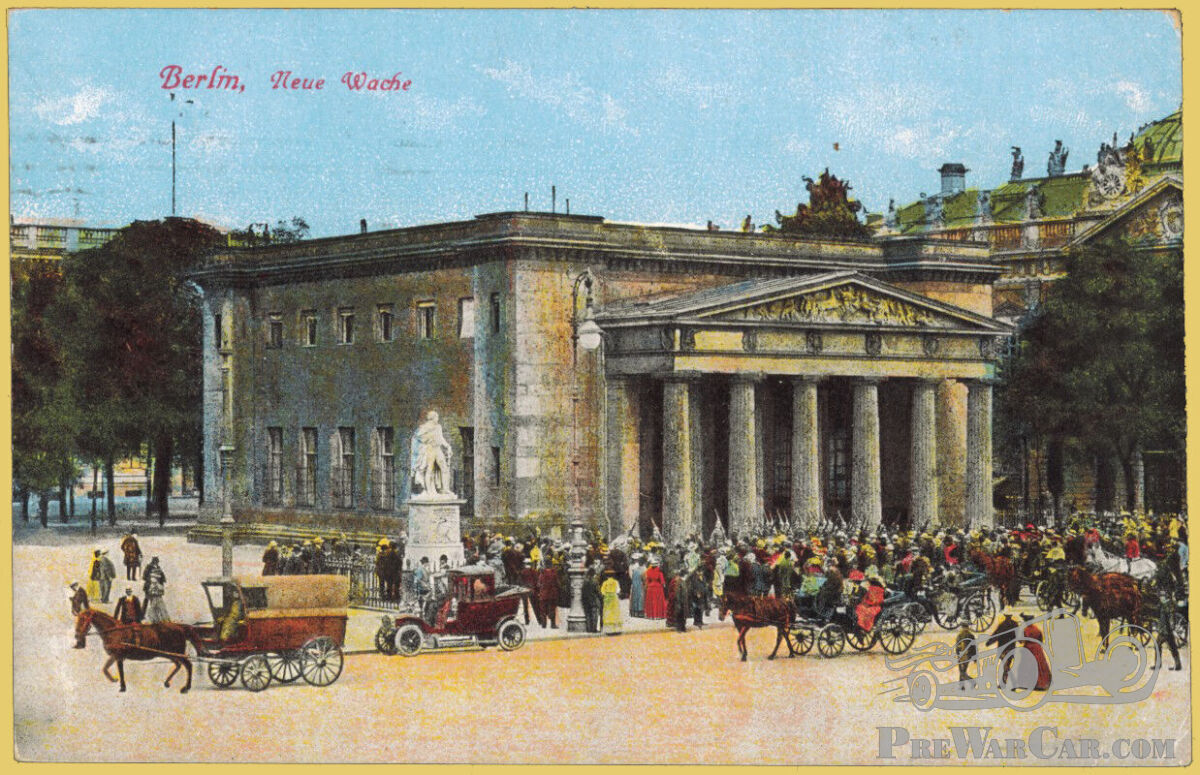
Here we see a contemporary postcard from the Neue Wache in Berlin, which in turn might lead us to ask what kind of car is depicted on it.
Lees verder
Dieckmann Hans
26 Juli 2024, 12:28
The vehicle owner was (Adolf?) Böcklin von Böcklinsau of Berlin, Unter den Linden 4/5.
--------------------------------------------------------------------
Fahrzeugeigentümer war (Adolf ?) Böcklin von Böcklinsau, Berlin, Unter den Linden 4/5.
Lees verder
--------------------------------------------------------------------
Fahrzeugeigentümer war (Adolf ?) Böcklin von Böcklinsau, Berlin, Unter den Linden 4/5.
Hergen Deuter
31 Juli 2024, 21:19
In Berlin's boulevard Unter den Linden 4 there was no residential building even around 1915, but the Neoclassical Neue Wache, built by Karl Friedrich Schinkel in 1818, was in those days used as the headquarters of the military command and is a memorial now. Adolf Böcklin von Böcklinsau was a lieutenant general, but probably should have been retired then, as he must have been already 77 years old.
Lees verder
Fredy Ley
29 Mei 2024, 11:45
Now that we have dealt with the rear dumb-irons, which were a copy of those used on horse-drawn vehicles, as well as right-handed knights (forget left-handed ones), I invite you to take a ride on the omnibus parked in front of the station. The Leipziger Allgemein Kraftomnibus A-G was equipped with Daimler, Dürkopp, and Büssing omnibuses. The photo shows a Büssing double-deck type Leipzig 35 PS omnibus from 1913.
Lees verder
Ivo Braeken
28 Mei 2024, 16:51
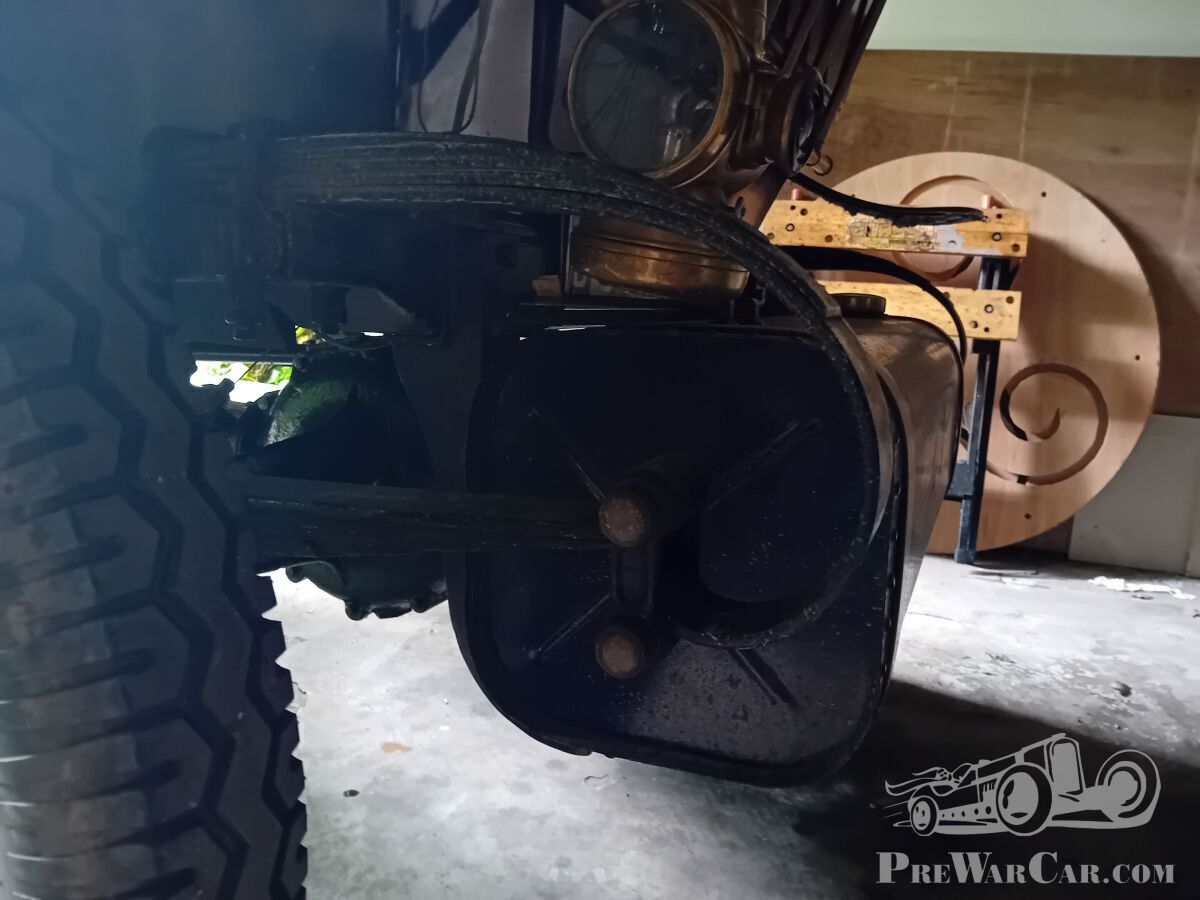
Another feature of Métallurgique is the lack of cooling fins in the bonnet and the wind tunnel under the car to suck warm air out. I include a photo of the dumb iron of a Métallurgique. I think it is a match.
Lees verder
Ariejan Bos
30 Mei 2024, 09:36
The spring system you show is the normal spring configuration of a Métallurgique during that period. The official name was "three-quarter elliptic spring with swan neck" (because of the downward curve at the end; in French: ressort demi-pincette à crosse). In rare cases you can observe half-elliptical springs with a transverse spring (e.g. in the case of the well-known 1911 Vanden Plas speedster in the Auburn-Cord-Duesenberg Museum in the US). The spring system on the Leipzig car has an outward curved dumb-iron, supporting the end of a half elliptic spring. For example Peugeot was a regular user of this system in these years, but I've never seen that on a Métallurgique.
Lees verder
Keith Kuehn
25 Mei 2024, 20:31
Okay, Ivo, you started this! It's a good question actually, as I bet a lot of folks that visit this website question a lot of early information and names. Now, I wonder how those parts got the name "dumb irons"!
I get asked a lot, "Why right hand drive?" I've always thought that was because ships had "port" and "starboard" or "Steering board", which is the right-hand side of the ship. Another reason I've heard is that is the side the coachman controlled the horses from... either explanation being good, of course.
Lees verder
I get asked a lot, "Why right hand drive?" I've always thought that was because ships had "port" and "starboard" or "Steering board", which is the right-hand side of the ship. Another reason I've heard is that is the side the coachman controlled the horses from... either explanation being good, of course.
Christoph Röhrs
26 Mei 2024, 21:49
Why right-hand drive? Another explanation for driving on the left-hand side of the road is that in earlier times knights also rode on the left-hand side, because then they had their right hand free for the sword towards the centre of the road in case of defence.
Lees verder
Keith Kuehn
24 Mei 2024, 20:01
Yes, Ariejan. Those dumb irons appear the same as my 1910 Alldays, and so does the radiator shape. I'm positive it is NOT an Alldays and Onions, though!
The motor car in the photo does appear to be a very sporty little fella though!
Lees verder
The motor car in the photo does appear to be a very sporty little fella though!

Fredy Ley
24 Mei 2024, 10:44
Going by the bonnet, I think this beautiful car is a Bergmann-Métallurgique "Victoria Coupé" 8/16hp with 1910 Van den Plas bodywork.
Lees verder
Ariejan Bos
24 Mei 2024, 13:41
I agree, though I have a bit of a problem finding a Métallurgique with similar rear dumb-irons.
Lees verder
Ariejan Bos
25 Mei 2024, 17:33
That is the cast-iron bracket holding the spring.
Lees verder