Het wereldwijde magazine en verkoopplatform voor liefhebbers van klassieke auto’s, door liefhebbers.
Het wereldwijde magazine en verkoopplatform voor liefhebbers van klassieke auto’s, door liefhebbers.


Filter
Maak een keuze
- Auto's
-
Merk >>
-
Bouwjaar >>
-
-
Categorie >>
- Motorfietsen
- Onderdelen
-
Automerk >>
-
Fabrikant >>
-
Categorie >>
- Fietsen
-
Bouwjaar >>
-
Landen


The bricklayer's Fortune (update: Crossley, Waverley, Daracq ?)
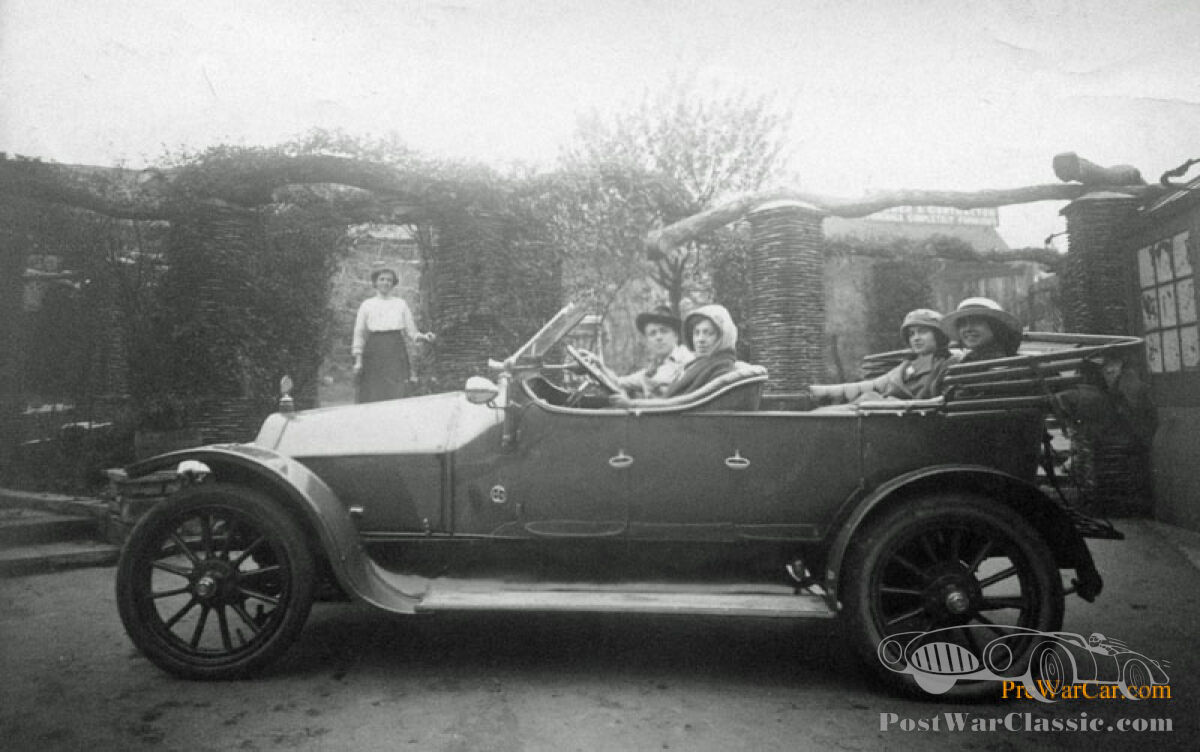

Jesse Walker sent an old family photo showing the family - named Harper - of his 2nd great grandfather in Nottingham in 1913 (when cars were very rare..! ) with his wife in the background and his four children in the car. His great grandfather probably took the picture himself.
We think the low radiator and the sharp edged bonnetare are most probably the best details to work with. But Jesse is not only curious what make of motorcar this can be. "Any info at all on the car would be appreciated, such as how would someone buy a car like this? Where was it made, purchased, shipped? I've had a look at other cars from 1913 or before and they look absolutely nothing like this one."
We asked Jesse to give some more background to the photo. To our experience this always adds a lot to the story.
" It's my great grandmother's family, with surname Harper. She's the one on the far right (back left seat of the car). The family had built up quite some money from a simple background. The father started as a bricklayer around 1880 when he was in his very early teens and steadily built up a construction empire doing all sorts of work (as can be seen on his sign in the background - "Builder & Contractor"). The son (the very dapper gent in the driving seat) had been to Nottingham Boys High School. He died in Belgium in 1918 aged 27, so the family money went to the three daughters.
The daughters lived long lives into the 1970s/1980s and never had to work a day in their lives. The story goes that they owned about 400-600 houses between themselves (a very conservative estimate in today's money would be about £100M if each house was worth £200K).. but there's nothing to show for it these days. All disappeared through mismanagement I'm told.
The father died in 1950 with an estate worth £58000, when the average UK annual salary was just over £100.. so yes, quite some means.
Well, we agree it is a high quality car. The details are to be produced by our knowlegeable audience.
Gepubliceerd:
zondag december 4th, 2016
Facebook
LinkedIn
Twitter
WhatsApp
Email
Copy
Reacties
Onbekend
06 December 2016, 17:59
Not very likely. The Henriod valveless engine was a failure, almost leading to the bankruptcy of the firm. After the retirement of M. Darracq the management of the firm came early 1912 into the hands of Owen Clegg, who had worked for Rover till that moment. Not surprisingly the new 16hp (poppet valve) engine was designed along the lines of the succesful 12hp Rover engine, for which Mr. Clegg was also responsible. The Darracq with this new engine was introduced early 1913 and that is probably the model we see on the photo.
Lees verder
Onbekend
06 December 2016, 11:29
Query though, is it a 1913 Darracq T13 with the Henriod "sans soupapes" engine
Lees verder
Onbekend
06 December 2016, 09:33
It is definitely a Darracg. An almost similar car can be found on the help pages of the SVVS, the Surrey Vintage Vehicle Society) (http://www.svvs.org/genpics10/1913_Darracq_12HP_Tourer.jpg), but now with frontal view.
Lees verder
Onbekend
05 December 2016, 20:36
If this helps, the design theme is clearly the integration of large and small long segments of the circle(top of radiator shroud, all fenders, double circle handles, front seat top, cowl top, etc.), which are a pleasing contrast with the steering wheel, wheels and tires, front mascot(?), headlights and driving lights. Only interrupted harshly by the bonnet top and side lines, far lower than torpedo style.
Lees verder
Onbekend
05 December 2016, 18:53
The money may have been lost through mismanagement, but that may be too harsh. My own forbears owned a very successful coachbuilding business in Tottenham and Essex Road, Islington, with showrooms that are still in existence in Upper Street, Islington. The profits were put into housing in east London: Tottenham and Walthamstow in particular. There were at least 100 when my great grandfather died in about 1950, and he 18,000 pounds in cash under the bed! I remember collecting rents with my grandfather. But here's the rub. The houses all had sitting tenants, who enjoyed rent control. The houses were almost worthless as investments, and my grandfather apparently hocked them off for 25 pounds each in the 1950's when he wanted some cash. Even in 1967, when he died, two of the houses, that happened to be next to each other, were valued for probate. The empty one was sold for 55,000 pounds, but the one with the sitting tenant was valued at 500 pounds; yes, 500 pounds. Since the tenant could last for 40 years or more, most people got out. Of course, large fortunes were lost, on paper, but the real loss was caused by rent control. At this distance, I have no problem with the redistribution of wealth this produced, but it was certainly savage for the property owners.
Lees verder
Onbekend
05 December 2016, 01:50
I offer Waverley as a possibility. There's a very similar car here in Queensland, though it has 10-spoke wheels and different door handles - perhaps it's the smaller of the two 1913 models.
Lees verder