Het wereldwijde magazine en verkoopplatform voor liefhebbers van klassieke auto’s, door liefhebbers.
Het wereldwijde magazine en verkoopplatform voor liefhebbers van klassieke auto’s, door liefhebbers.


Filter
Maak een keuze
- Auto's
-
Merk >>
-
Categorie >>
- Motorfietsen
- Onderdelen
-
Automerk >>
-
Fabrikant >>
-
Categorie >>
- Fietsen
-
Bouwjaar >>
-
Landen


Round Radiator Racer Mystery. ( 1913 Spyker 25/30 HP !)
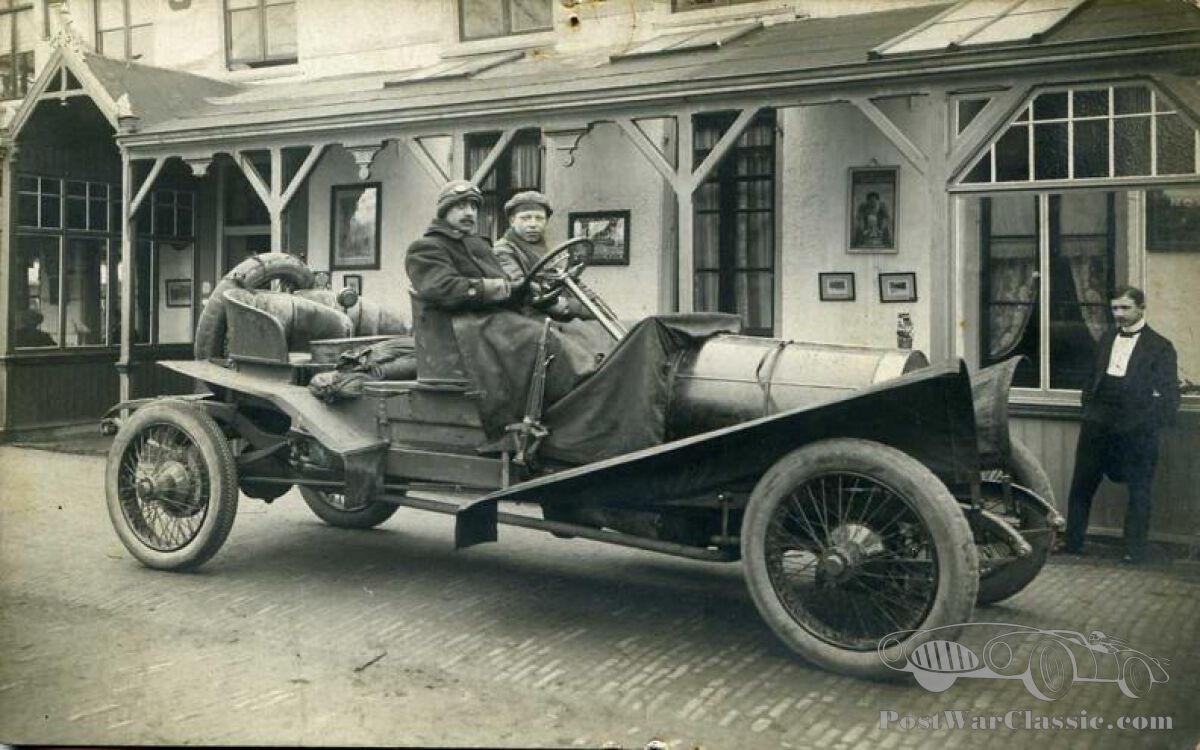


Arent G.Westera writes: "A couple of years ago I got this photo. I asked a few people with knowledge of old cars, but none of them could say for certain what it is.
One suggested it might be a Gregoire. Another was pretty certain it is an old Benz.
I would love to hear from somebody who is certain about this car."
editor: the round radiator mysteries are hard to solve. But this particular car should be a wellknown example. One would say it is a factory racer or test prototype. No headlights, canvas or leather wings. No gastank ???? This no standard, run of the mill machine. Due to the long wheelbase it is not the typiocal racer, maybe a lomng distance machine. French? We are eager to hear your opinion.
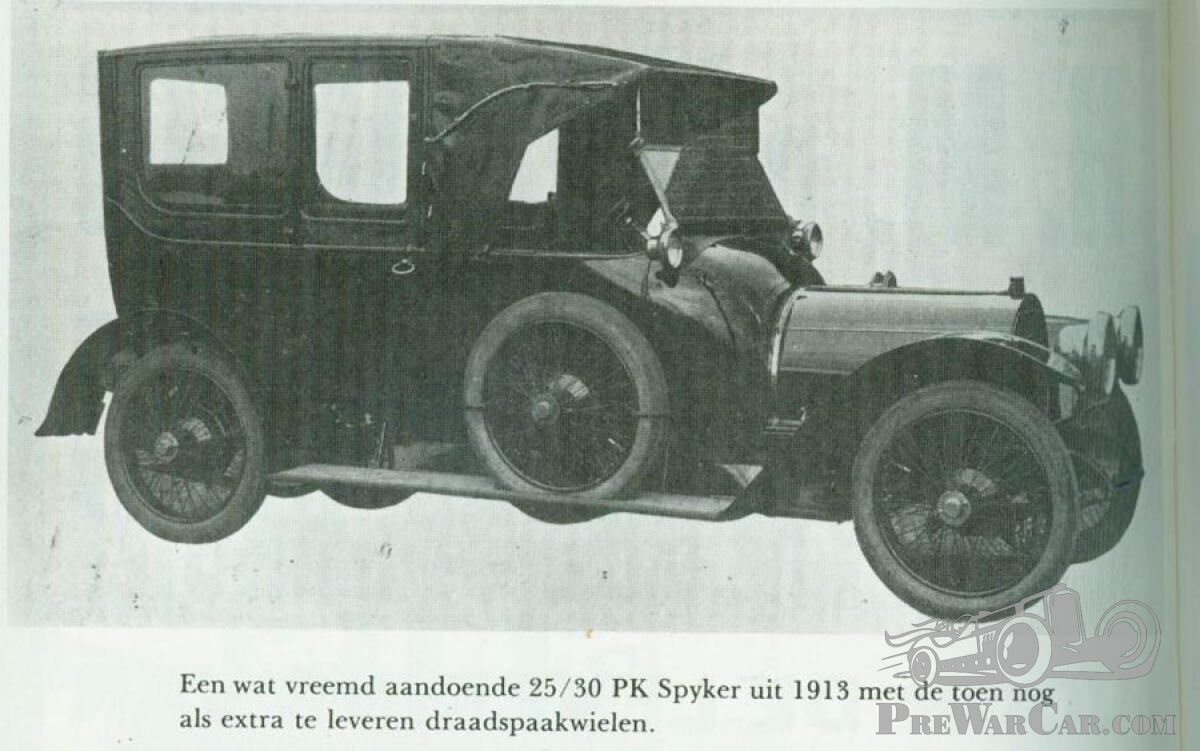
Update by Kees-Jan Boosman who produced a spot on identificatioon of this 1913 Spyker 25/30 HP, all details match. A prototype or chassis-engine test: "The background and setting looks like The Netherlands to me. Certainly the roof lights above the windows to give adequate light to the interior are an unusual feature and point at a Northern European location. Have you also noted the framed pictures hanging on the outside wall of the building?
This setting in combination with a round radiator raises the question if it can be a (prototype) Spyker.
In the book on Spyker by Wim Oude Weernink (1st edition, page 92) is pictured a very identical 25/30 from 1913 with wirewheels and a bonnet that is not tapered and without any louvres.
Also is the inverted front shackle of the rear spring a feature that was used by Spyker at that time.
Gepubliceerd:
donderdag april 19th, 2012
Facebook
LinkedIn
Twitter
WhatsApp
Email
Copy
Reacties
Onbekend
23 April 2012, 13:56
I agree with the Riley option, these wheels indeed have the same wire configuration and apparently were widely used (at least according to the ad text). It is remarkable, that there is no or hardly any information on these wheels, whereas ads and info on Rudge-Whitworth wheels can be found relatively easy!
Lees verder
Onbekend
23 April 2012, 04:42
A guess,Rudge wheels?
Graham.
Editor: see recent parts advert; according to that it could be Riley as well.
Lees verder
Graham.
Editor: see recent parts advert; according to that it could be Riley as well.
Onbekend
22 April 2012, 14:58
Kees Jan, congratulations! It is clearly a Dutch habit to ignore one's own products. Spyker came to my mind earlier but I rejected the idea before checking only because of the size of the car. And even now I am impressed by its size!
The wire wheels were not Continental by the way, but they were used by Continental on their stand at the 1912 Paris Salon. Does anyone know who produced this type of wheels? I cannot find any reference.
editor: I just happened to find that Riley(!) made these or similar wheels in that time. Check this item in the parts section:
http://www.prewarcar.com/index.php?option=com_caradvert&view=ad§ion_id=3&id=65925&Itemid=433
Lees verder
The wire wheels were not Continental by the way, but they were used by Continental on their stand at the 1912 Paris Salon. Does anyone know who produced this type of wheels? I cannot find any reference.
editor: I just happened to find that Riley(!) made these or similar wheels in that time. Check this item in the parts section:
http://www.prewarcar.com/index.php?option=com_caradvert&view=ad§ion_id=3&id=65925&Itemid=433
Onbekend
22 April 2012, 08:06
The background and setting looks like The Netherlands to me. Certainly the roof lights above the windows to give adequate light to the interior are an unusual feature and point at a Northern European location. Have you also noted the framed pictures hanging on the outside wall of the building?
This setting in combination with a round radiator raises the question if it can be a (prototype) Spyker.
In the book on Spyker by Wim Oude Weernink (1st edition, page 92) is pictured a very identical 25/30 from 1913 with wirewheels and a bonnet that is not tapered and without any louvres.
Also is the inverted front shackle of the rear spring a feature that was used by Spyker at that time.
Lees verder
This setting in combination with a round radiator raises the question if it can be a (prototype) Spyker.
In the book on Spyker by Wim Oude Weernink (1st edition, page 92) is pictured a very identical 25/30 from 1913 with wirewheels and a bonnet that is not tapered and without any louvres.
Also is the inverted front shackle of the rear spring a feature that was used by Spyker at that time.
Onbekend
21 April 2012, 20:09
Though I have no definitive clou yet for the make of this car, there is a lot to say about the rest. It looks as if the photograph is taken during some kind of test run before a locality with a curious 'garçon' somewhere in France (or Belgium?) . The seating arrangement is primitive, behind the front seat some bags are lying (filled with sand for extra weight?) and the mudguards are improvised. The fuel tank will probably be located beneath the front seats, not uncommon in these days. The (very large) car has some resemblance to Hotchkiss indeed (the 1912 model AD is certainly of the same size and appearance), but there are many differences, an important one being the absence of louvres in the bonnet. Wire wheels were not common for larger cars before 1912 (by the way, Hotchkiss used wire wheels already in 1906 for their Grand Prix cars!). The wire pattern of the wheels suggests Continental wheels of circa 1912.
Lees verder
Onbekend
21 April 2012, 14:19
Round radiator was very popular in that time particularly in France. So it could be also Optima or Cottereau. The right rear tire looks like Michelin anti-skid tread.
Lees verder
Onbekend
20 April 2012, 14:29
Looking at bonnet, radiator and lenght I would also go for the Delaunay Belleville maybe a "stripped down" tourer?
Lees verder
Onbekend
20 April 2012, 11:28
Quite possibly a Hotchkiss; the company were active in racing in the Edwardian period. Hard to state with any certainty as there is little to go on other than the round radiator , so much of which s obscured, and the hubs.
Regards,
Gareth
Lees verder
Regards,
Gareth
Onbekend
20 April 2012, 11:02
My guess is Hotchkiss, not unlike this 1912 model http://www.conceptcarz.com/vehicle/z11042/Hotchkiss-AD.aspx
Lees verder
Onbekend
20 April 2012, 09:07
Maybe I am totally wrong, bu several details make remind my own 1908 Riley V2. The wheels have the same locks as the Riley, the dumbirons are very similar. Could this photo be from Paris Madrid 1908?
Lees verder
Onbekend
20 April 2012, 04:48
for the long wheelbase it could be a delaunay-belleville
regards
mike
Lees verder
regards
mike