Het wereldwijde magazine en verkoopplatform voor liefhebbers van klassieke auto’s, door liefhebbers.
Het wereldwijde magazine en verkoopplatform voor liefhebbers van klassieke auto’s, door liefhebbers.


Filter
Maak een keuze
- Auto's
-
Merk >>
-
Bouwjaar >>
-
-
Categorie >>
- Motorfietsen
- Onderdelen
-
Automerk >>
-
Fabrikant >>
-
Categorie >>
- Fietsen
-
Bouwjaar >>
-
Landen


Different ways of transport in London
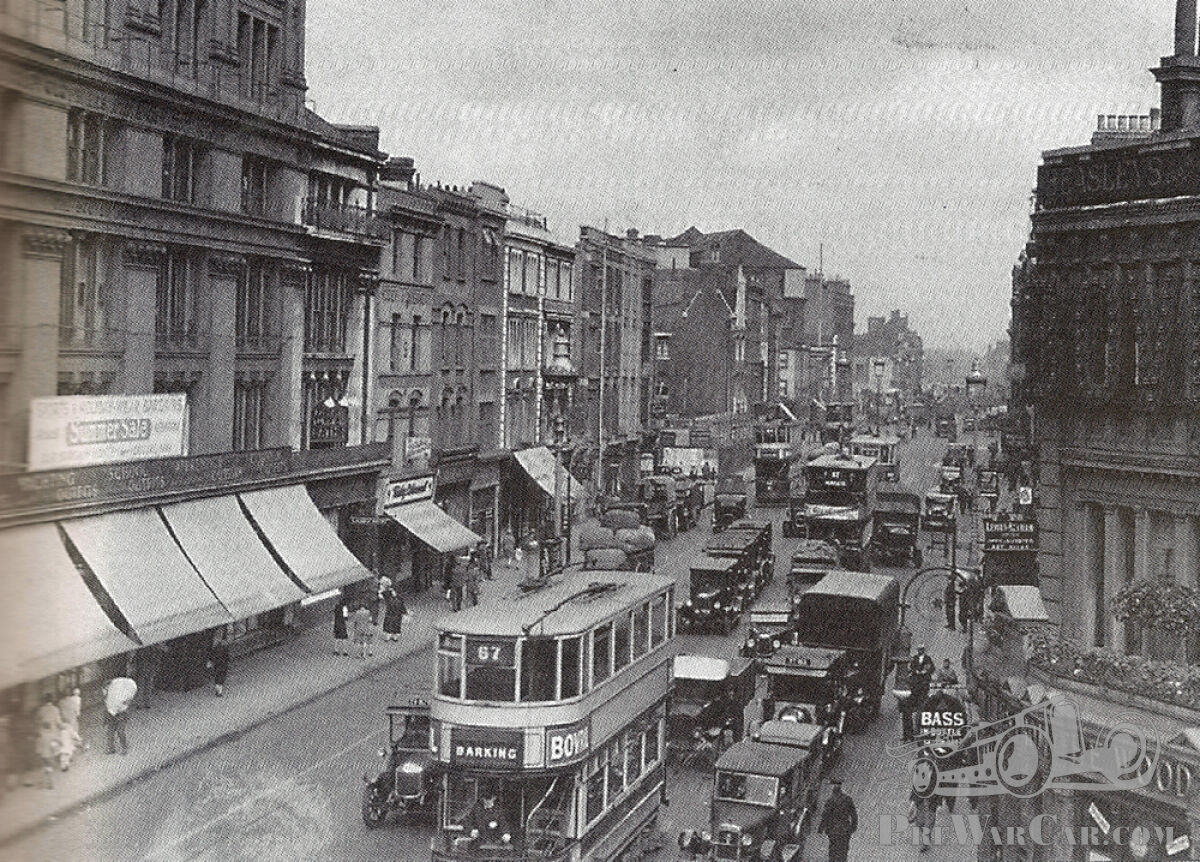

Here we see a photograph of the capital city of England and the United Kingdom, London! But then back in 1930. What is different on the photograph, compared to when we would visit this cultural capital of the world, as often described, today?
It already was quite busy as we can see on Gardiner's Corner, the Scotch House on number 1 to number 5 Commercial Road. On number 7 was Nevill's Turkish Baths Ltd located we know from the description. But nowadays there is even more (much more) traffic...
The ways of transport have of course also changed, where in the foreground we see tram number 67 to Barking. The London General omnibuses were also there, as can be seen, back then they were still run by independent companies. But this would change with the London Passenger Transport Act of 1933. Nowadays (almost) all buses are exchanged for the well-known red double-deckers.
Besides this, they have added a very extensive underground metro system. Actually, the underground was already there at the time the photograph was taken. London has the oldest underground railway network in the world. Previously known as the Metropolitan Railway, which opened in 1863. The first actual line that operated underground was in 1890 with electric traction trains and is still part of the current system.
And what do you think of the Emirates Air Line cable car from Greenwich Peninsula to the Royal Docks terminals? Of course, we must not forget the typically English black cabs. All make it possible to go sightseeing around London and visit the London Eye, The Shard, the Tower Bridge, the Houses of Parliament, Canary Wharf, the Tate Modern, and so on...
When you visit this wonderful city, take your time to see (all) the highlights and use different ways of transport (of course there are many more ways to explore the city). The best time to go there is, of course, the first weekend of November during the London-Brighton run ;)
Source photograph: The changing east end Stepney, Bethnal Green & Poplar; Rosemary Taylor-Christopher Lloyd.
Gepubliceerd:
donderdag mei 31st, 2018
Facebook
LinkedIn
Twitter
WhatsApp
Email
Copy
Reacties
Steve Bousfield
31 Mei 2018, 18:16
Several comapanies operated London's electric trams. The largest operator. LCC, picked up from a conduit between the rails. Other operators used the overhead pick up system. Many trams had to be equipped with both forms of electricity pick up and there were changeover points along the routes where they could swap between over or under.
Lees verder
Larry A. Lewis
31 Mei 2018, 17:19
The tram has two trolley poles, both are down. In this area the current is collected from a conduit between the rails; London trams didn't run on batteries as far as I know.
Lees verder
John Bates
31 Mei 2018, 13:20
The pantograph (electricity collector) on the tram is down so is it running on batteries? The driver is in position and it looks as though he is expecting the tram to move! The pantograph is also facing in the wrong direction, another pointer to the vehicle running on batteries? In any case, I can see no overhead wires.
Lees verder