Het wereldwijde magazine en verkoopplatform voor liefhebbers van klassieke auto’s, door liefhebbers.
Het wereldwijde magazine en verkoopplatform voor liefhebbers van klassieke auto’s, door liefhebbers.


Filter
Maak een keuze
- Auto's
-
Merk >>
-
Bouwjaar >>
-
-
Categorie >>
- Motorfietsen
- Onderdelen
-
Automerk >>
-
Fabrikant >>
-
Categorie >>
- Fietsen
-
Bouwjaar >>
-
Landen


Gobron-Brillié opnieuw: Rigolly's 100 mph-racer
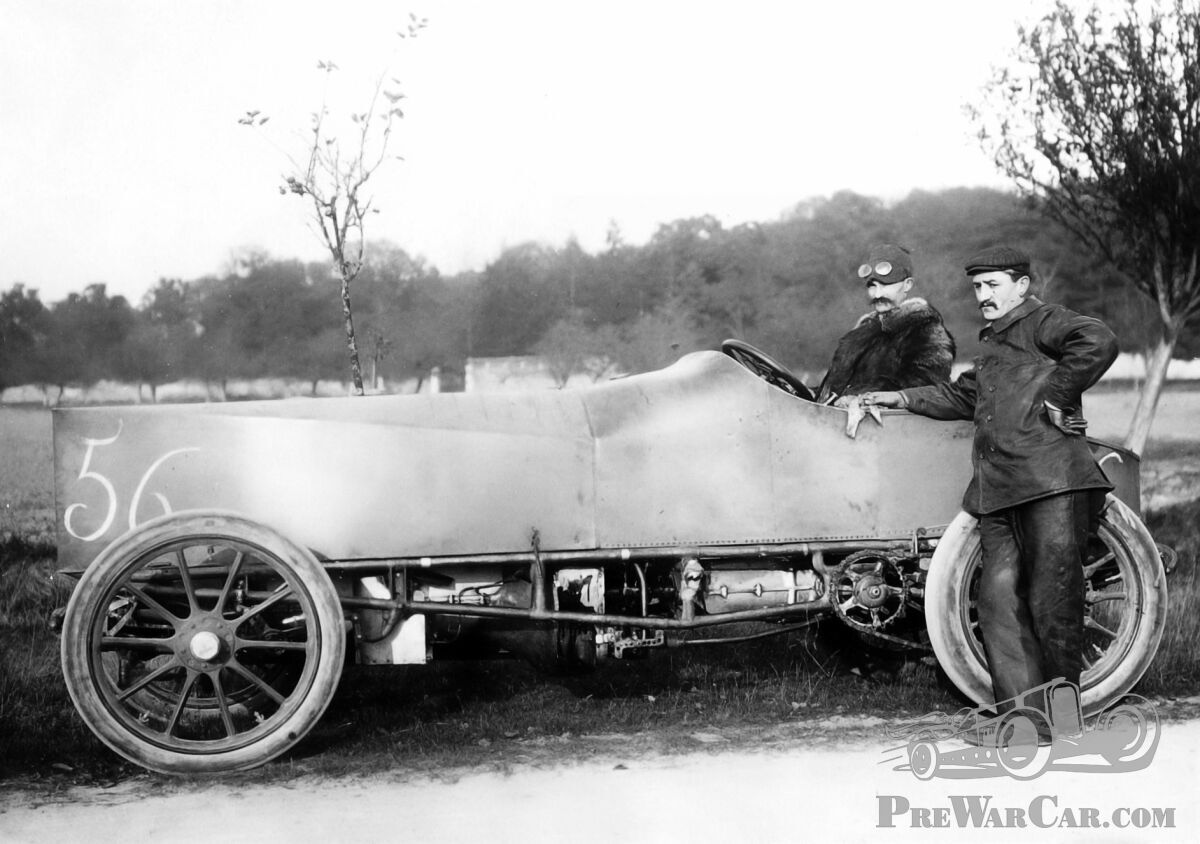

De afgelopen maanden hebben we u al meerdere keren laten kennismaken met Gobron-Brillié. Het eerste artikel verscheen in mei, gevolgd door nog een verhaal over de racewagens van het merk in juni. Nu er opnieuw een maand is verstreken, vonden we het tijd om nog één keer aandacht te besteden aan deze buitengewone Franse constructeur.
De auto op deze foto zou Louis Rigolly's 100 pk sterke Gobron-Brillié zijn tijdens de Côte de Gaillon-heuvelklim van 30 oktober 1904. Hij werd aangedreven door de eerder beschreven motor met tegenover elkaar liggende zuigers en is waarschijnlijk dezelfde auto waarmee Rigolly op 21 juli 1904 tijdens de Ostend Automobile Week in België geschiedenis schreef. Daar noteerde hij over de vliegende kilometer een indrukwekkende snelheid van 166,665 km/u en werd hij de eerste mens die met een auto sneller reed dan 100 mph (160 km/u).
Rigolly's Gobron-Brillié zou voorzien zijn geweest van een lichtgewicht carrosserie op een buizenchassis, al blijkt betrouwbare informatie over deze auto verrassend schaars. Misschien weet een van onze lezers meer? Wel ontdekten we dat Rigolly's racecarrière relatief kort duurde. In 1906 kwam daar een einde aan, toen Gobron-Brillié zich geleidelijk terugtrok uit de internationale top van de autosport. Daarna leidde hij een teruggetrokken leven in Frankrijk, overleefde beide wereldoorlogen en overleed uiteindelijk in 1958 op 82-jarige leeftijd.
Tekst: Jeroen Booij
Foto: bron onbekend
Gepubliceerd:
maandag augustus 10th, 2026
Facebook
LinkedIn
Twitter
WhatsApp
Email
Copy
Reacties
Graham Rankin
10 Augustus, 10:15
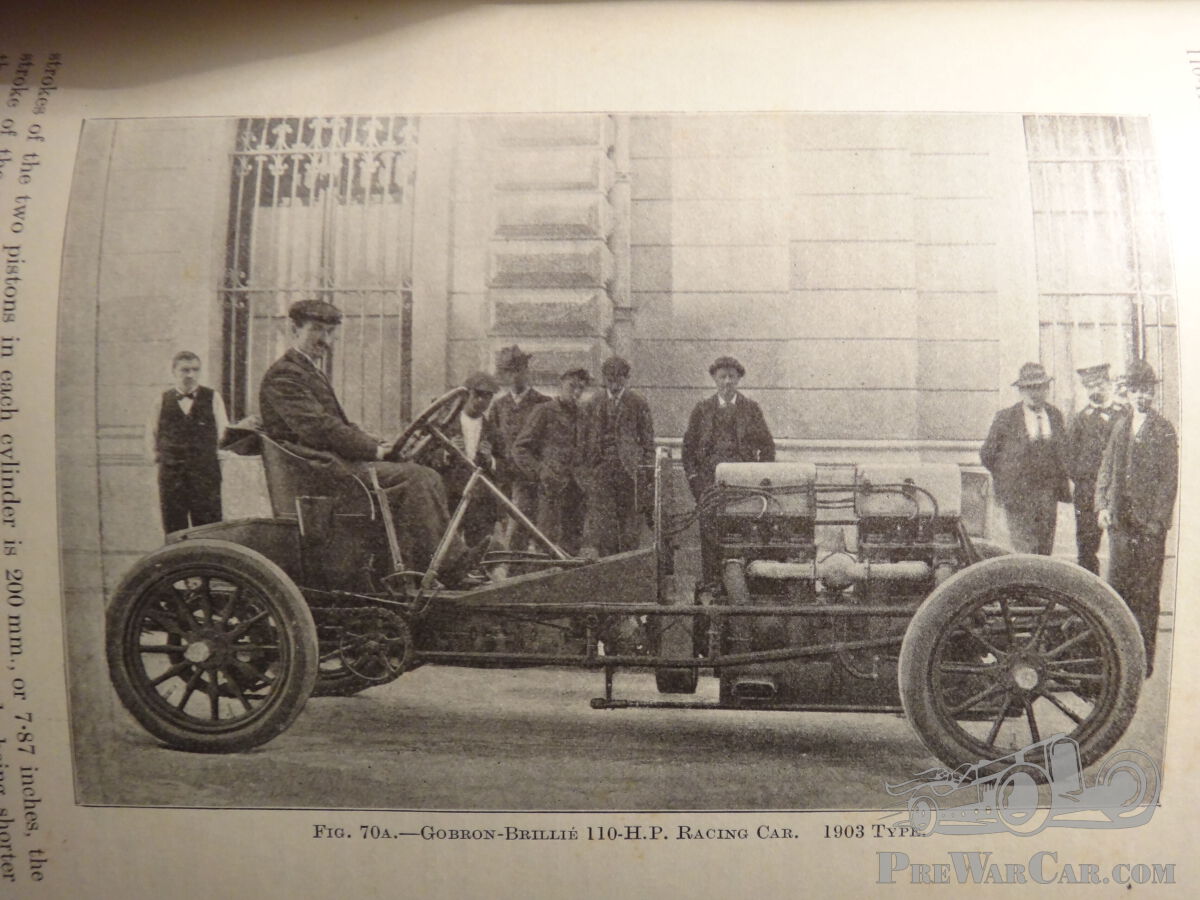
Here is another photo of a 110 HP race car from 1903 which may interest readers and which is extracted from the ever wonderful W. Worby-Beaumont publication---Archibald Constable & Company Ltd, 16 James Street, London--1906. Volume 2. (42 Shillings net).
...."Of the car illustrated, it may be mentioned that the engine is of nominally 110 HP and it has cylinders of 140mm, or 5.51 inches bore. The combined strokes of the two pistons in each cylinder is 200mm, or 7.87 inches, the stroke of the upper pistons, with the long connecting rods, being shorter than that of the lower pistons, and as arranged in the smaller engines. The stroke of the lower pistons is about 1.27 times greater than that of the upper pistons. During 1904 Rigolly drove the racing car of that year's construction at a recorded speed of nearly 95 miles per hour."....
Lees verder
...."Of the car illustrated, it may be mentioned that the engine is of nominally 110 HP and it has cylinders of 140mm, or 5.51 inches bore. The combined strokes of the two pistons in each cylinder is 200mm, or 7.87 inches, the stroke of the upper pistons, with the long connecting rods, being shorter than that of the lower pistons, and as arranged in the smaller engines. The stroke of the lower pistons is about 1.27 times greater than that of the upper pistons. During 1904 Rigolly drove the racing car of that year's construction at a recorded speed of nearly 95 miles per hour."....
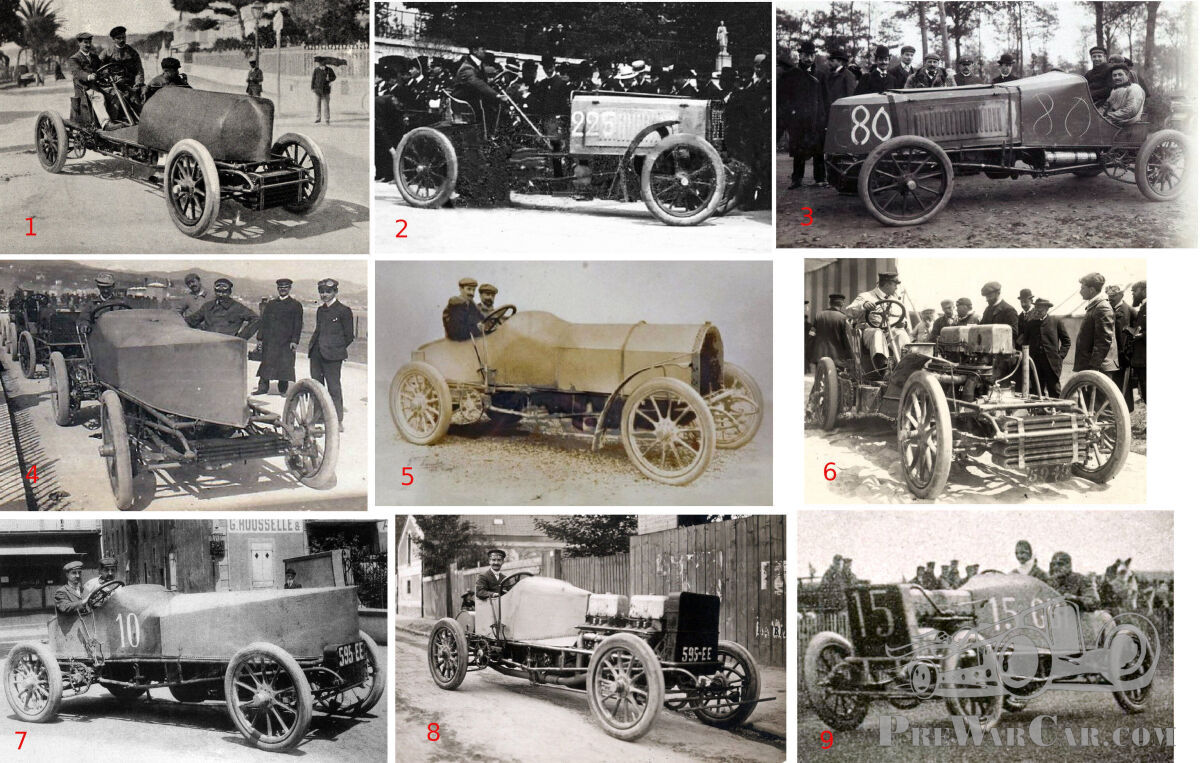
It is remarkable that Gobron-Brillié continued to use this tubular frame till and with the 1907 Grand Prix de l’ACF, when in fact all other makes had already changed to pressed steel frames for years. As I stated before, the car was fast and performed well on relatively short races, but during long distance races, especially during the circuit races with their many turns and braking moments, they either didn’t perform well or were even forced to withdraw by mechanical failure like worn-out tyres or broken radiators. It could well be that a lot of trouble was caused by frame torsion due to the large and powerful engine.
In the uploaded image I’ve collected the different appearances of the car in the 1903-1907 period, showing the first time a change was observed: 1. Semaine de Nice 1903 (Rigolly); 2. Paris-Madrid 1903 (Duray); 3. Kilomètre de Dourdan 1903 (Duray); 4. Semaine de Nice 1904 (Rigolly); 5 and 6. Gordon Bennett trials 1904 (Rigolly resp. Burton); 7. Gordon Bennett trials 1905 (Rigolly); 8. Grand Prix de l’ACF 1906 (Rigolly); 9. Grand Prix de l’ACF 1907 (Rigolly). The 1906 and 1907 Grand Prix cars seem to be more or less identical.
To be continued …?