Het wereldwijde magazine en verkoopplatform voor liefhebbers van klassieke auto’s, door liefhebbers.
Het wereldwijde magazine en verkoopplatform voor liefhebbers van klassieke auto’s, door liefhebbers.


Filter
Maak een keuze
- Auto's
-
Merk >>
-
Bouwjaar >>
-
-
Categorie >>
- Motorfietsen
- Onderdelen
-
Automerk >>
-
Fabrikant >>
-
Categorie >>
- Fietsen
-
Bouwjaar >>
-
Landen


Mystery solved: one of three original Gladiator Paris-Berlin racers discovered




After the Paris-Amsterdam race of 1898, the second international city to city race was organised by the Automobile Club de France in 1901. Berlin was the final goal, which was interesting from a political perspective but understandable from sportive considerations. Germany could be considered in fact to be the founding father of the French car industry, and maybe this race would help to improve the politically troubled relations between both countries. The disputed Alsace Lorraine region was avoided by passing through Luxembourg and further through Aix-la-Chapelle, Münster and Hanover. The (one way) race proved to be a success, was won by Fournier on a Mors and took place without major incidents.
A unique Paris-Berlin survivor
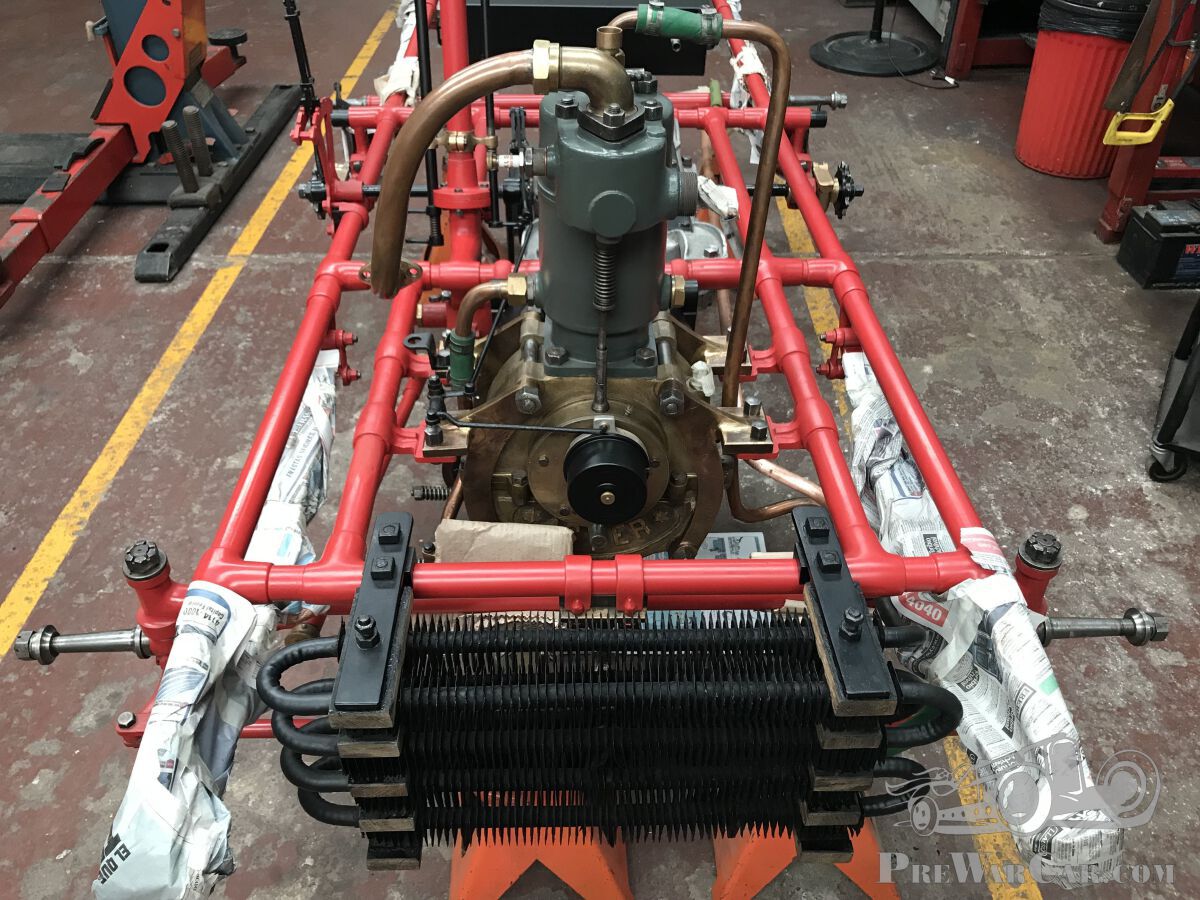
I wasn't aware of any survivors of this race until recently when I received a detailed report of a formerly unidentified restoration object of around 1900. This car had been rescued from a cellar around 1960 and was auctioned in 2005 as part of the Sharpe family collection. It was driven by two coupled single-cylinder water-cooled Aster engines, a system not uncommon in these years. Bugatti had used two single-cylinder engines on one of his designs working at Prinetti & Stucchi, and Vivinus (and thus their British licensee New Orleans) had used it in one of their early designs. Also, Georges Richard had used a similar system in 1901, but he had been a Vivinus licensee too and although the car looked different from the Vivinus and the engines were cooled by water instead of air, the inspiration undoubtedly came from Vivinus.
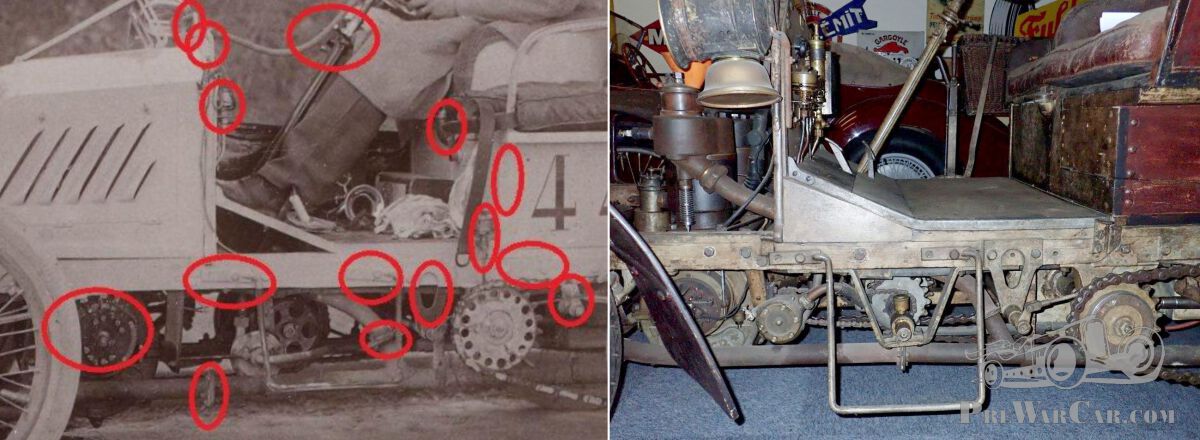
During the research of the unidentified vehicle, a remarkable similarity was found with one of the three Gladiator racers as used during this Paris-Berlin race and photographed at the start by Jules Beau. In many details the car is similar to this racer and the small differences can be explained as improvements during its further life, so I have no doubt that it is indeed one of the three participants. For the present owner, the moment of this find must have been one of true bliss! As photos of the two other cars have not emerged yet, it is difficult, however, to tell which of the three cars has survived.
Gladiator, part of the Clément-Gladiator firm, located in France but British owned at the time, had entered three vehicles in the light car section (up to 650 kgs), raced by Mercier (nr. 44), Demester (nr. 45) and Mercey (nr. 46). Only Mercey would make it to the finish (as 34th), the two others had to abandon. After the race at least one of the cars would have returned to England, as reported in The Motor-Car Journal of April 27, 1901. This car was rebuilt for road use with a tonneau body, with which it was recovered around 1960. Rebuilding racing cars for road use was common practice in these days and understandable while many of the early racers were not much different from normal road cars. The story of the car after the race is a remarkable and a tragic one as well, as told in the original auction report: “The lady from whom it was acquired explained that her brother had bought the car second-hand in about 1903 and they had used it regularly. Eventually, the radiator developed a serious leak and was sent away for repair, never to be seen again. At the outbreak of the First World War, her brother took the car to pieces so that it could be taken down into the cellar, whilst he then went to the trenches – from which he did not return.”
Almost 50 years later the car saw daylight again and 60 years after that moment the present owner undoubtedly will bring her back to her former racing and touring condition. We all look forward to her glorious reappearance!
Words by Ariejan Bos. Photographs by Jules Beau present in the collection of the Biblothèque nationale de France (Gallica-BnF).
Gepubliceerd:
maandag mei 11th, 2020
Facebook
LinkedIn
Twitter
WhatsApp
Email
Copy
Reacties
Shaun Crofton
15 Mei 2020, 10:51
As the underbidder on this car at the Sharpe auction I was disappointed and relieved at the same time. Before the sale I had attempted to sit in the car and was very surprised to find that in its configuration as offered for sale it would have been impossible to drive because the firewall was too close to the back of the seats-this is not obvious from the photographs offered here. The transmission as assembled then was incomplete and would not have been a practical means of driving the car but that having been said I was sorely tempted. I have always been amazed that it has been sat in the Netherlands for so many years with no apparent progress. I look forward to seeing the car as restored but would be happy to buy it in its current state at what was paid for it at the Sharpe sale?
Lees verder
Peter Maguire
14 Mei 2020, 14:12
While it may be a 'similar' car, it is definitely not car No. 44.
All the brackets in the second (modern) photo located in slightly diffrent positions (bracket angles, etc). Shame that things are highlighted as it prevents a proper comparison. In any case there seems no sign that holes have been re-drilled or items repositioned. Some other highlighted items are similar, but not exactly the same.
As far as I can see from the photos, the car 'as found' does not seem to have been got-at in terms of having been greatly modified. I guess the chassis is armoured wood and very correct.
I agree that there are some similarities, but that proves little one way or another. it could be that the three cars were very differnt in detail. If so, it could be one of the others - or a 'works replica' (!), perhaps for a customer who had sporting aspirations!
The current body fitted appears to be constructed with the rear portion removabe to creat a two-seater. Is this the case? It would be interesting to know as this could point to a car constructed - as I suggest - after the race for a customer who wanted to compete in other sporting events.
More evidence and I may change my mind, but for me there is insufficient so far.
All stay well in these difficult times,
Best regards, Peter Maguire.
Lees verder
All the brackets in the second (modern) photo located in slightly diffrent positions (bracket angles, etc). Shame that things are highlighted as it prevents a proper comparison. In any case there seems no sign that holes have been re-drilled or items repositioned. Some other highlighted items are similar, but not exactly the same.
As far as I can see from the photos, the car 'as found' does not seem to have been got-at in terms of having been greatly modified. I guess the chassis is armoured wood and very correct.
I agree that there are some similarities, but that proves little one way or another. it could be that the three cars were very differnt in detail. If so, it could be one of the others - or a 'works replica' (!), perhaps for a customer who had sporting aspirations!
The current body fitted appears to be constructed with the rear portion removabe to creat a two-seater. Is this the case? It would be interesting to know as this could point to a car constructed - as I suggest - after the race for a customer who wanted to compete in other sporting events.
More evidence and I may change my mind, but for me there is insufficient so far.
All stay well in these difficult times,
Best regards, Peter Maguire.
Mike Clark
12 Mei 2020, 22:35
Surely if they were a pair of Aster engines they would have had to be a "handed pair" - one clockwise, one anticlockwise. Possible for a manufacturer but unlikely for a later modification.
Mike
Lees verder
Mike
Jos van Genugten
13 Mei 2020, 14:13
An engine with a atmospherical inlet valve and symmetrical conrods can run in both directions with only the ignition system mirrored.
Lees verder
Juan Molinari
11 Mei 2020, 19:41
From 1901 Clément-Gladiator cars were built at the Levallois-Perret factory and by 1902 production was over 1,000 cars per annum, 800+ of which were sold in England. Some of these cars were equipped with engines manufactured nearby in Saint-Denis Paris by Aster in single, twin or four cylinder configurations how do we know this is not a normal and original Gladiator Tonneau car with two Aster engines ?. There is any probe about its racing heritage? Above tis a 1901 Boyer normal engine, same as the Gladiator...(take alook to the carb either.
Lees verder
Ariejan Bos
12 Mei 2020, 09:03
Dear mr. Molinari, I agree that at the moment I do not have hard evidence of this car having competed in the Paris-Berlin race. However, the resemblance of this car with the Gladiator racer as photographed by Jules Beau is such, even in small details like brackets, that I have no doubt that this car, if not the same, was certainly a similar car. Clearly this car was developed especially for the Paris-Berlin race and in technical layout she doesn't look like any of the standard Gladiator light cars of this period (my comment on this wasn't entirely correct). She even doesn't look like the example of the racer, as pictured in The Motor Car Journal several months before the race, so apparently many changes were made in a short period of time. On the other hand, at the moment we don't have pictures of the two other racers, so another possibility is that the three cars weren't identical and that at least one of these was similar to the example in the mentioned Journal.
Of course information of this period is scarce, so if you have any substantial information which could enlighten the history of this car we hope you'll share it with us.
About the photo you showed us, that is an interesting and beautiful vehicle too! Could you give us some more information about it? Thank you!
Lees verder
Of course information of this period is scarce, so if you have any substantial information which could enlighten the history of this car we hope you'll share it with us.
About the photo you showed us, that is an interesting and beautiful vehicle too! Could you give us some more information about it? Thank you!
Christopher Musk
11 Mei 2020, 16:57
What a facinating find made more so with the identification.
I hapen to have an Aster radiator from a generating set of not dissimilar peiod and wonder if that would be suitable for the car?
It measures approximately 855mm tall including the filler neck x 610mm x 610mm with the core 115mm thick giving a cooling area of approx 0.37 square metres.
Perhaps you could pass this on to the present owner.
Many thanks for the good work you are doing - it helps keep me sane in these difficult times.
My best wishes to you all
Keep Well
Christopher Musk
Lees verder
I hapen to have an Aster radiator from a generating set of not dissimilar peiod and wonder if that would be suitable for the car?
It measures approximately 855mm tall including the filler neck x 610mm x 610mm with the core 115mm thick giving a cooling area of approx 0.37 square metres.
Perhaps you could pass this on to the present owner.
Many thanks for the good work you are doing - it helps keep me sane in these difficult times.
My best wishes to you all
Keep Well
Christopher Musk
henri lalanne
11 Mei 2020, 15:38
en grattant la peinture sous les sieges avants ,vous devriez retrouver les numeros de course ,car les sieges ne semblent pas les memes que la 44
En tout cas bravo c'est une fabuleuse decouverte et histoire
Moi j'avais decouvert dans les annees 70 la Georges Richard 1 cyl Paris Berlin dans la region de Villeneuve sur Lot (47)et qui doit etre gardée dans un garage car on ne la plus jamais revue dans les rallyes
et aussi la Motobloc de Dombret du Paris Madrid 1903 qui se trouve maintenant en UK
Lees verder
En tout cas bravo c'est une fabuleuse decouverte et histoire
Moi j'avais decouvert dans les annees 70 la Georges Richard 1 cyl Paris Berlin dans la region de Villeneuve sur Lot (47)et qui doit etre gardée dans un garage car on ne la plus jamais revue dans les rallyes
et aussi la Motobloc de Dombret du Paris Madrid 1903 qui se trouve maintenant en UK
The PreWarCar.com Team
11 Mei 2020, 17:07
Translation:
By scratching the paint under the front seats, you should find the race numbers, because the seats do not look the same as the 44.
Anyway, congratulations, it's a fabulous discovery and history.
In the 70s I discovered the Georges Richard 1 cyl Paris Berlin in the region of Villeneuve sur Lot (47) which must be kept in a garage because we never saw it again in rallies.
The Dombret Motobloc from Paris Madrid 1903 is now in UK
Lees verder
By scratching the paint under the front seats, you should find the race numbers, because the seats do not look the same as the 44.
Anyway, congratulations, it's a fabulous discovery and history.
In the 70s I discovered the Georges Richard 1 cyl Paris Berlin in the region of Villeneuve sur Lot (47) which must be kept in a garage because we never saw it again in rallies.
The Dombret Motobloc from Paris Madrid 1903 is now in UK