Het wereldwijde magazine en verkoopplatform voor liefhebbers van klassieke auto’s, door liefhebbers.
Het wereldwijde magazine en verkoopplatform voor liefhebbers van klassieke auto’s, door liefhebbers.


Filter
Maak een keuze
- Auto's
-
Merk >>
-
Bouwjaar >>
-
-
Categorie >>
- Motorfietsen
- Onderdelen
-
Automerk >>
-
Fabrikant >>
-
Categorie >>
- Fietsen
-
Bouwjaar >>
-
Landen


Swiss Air
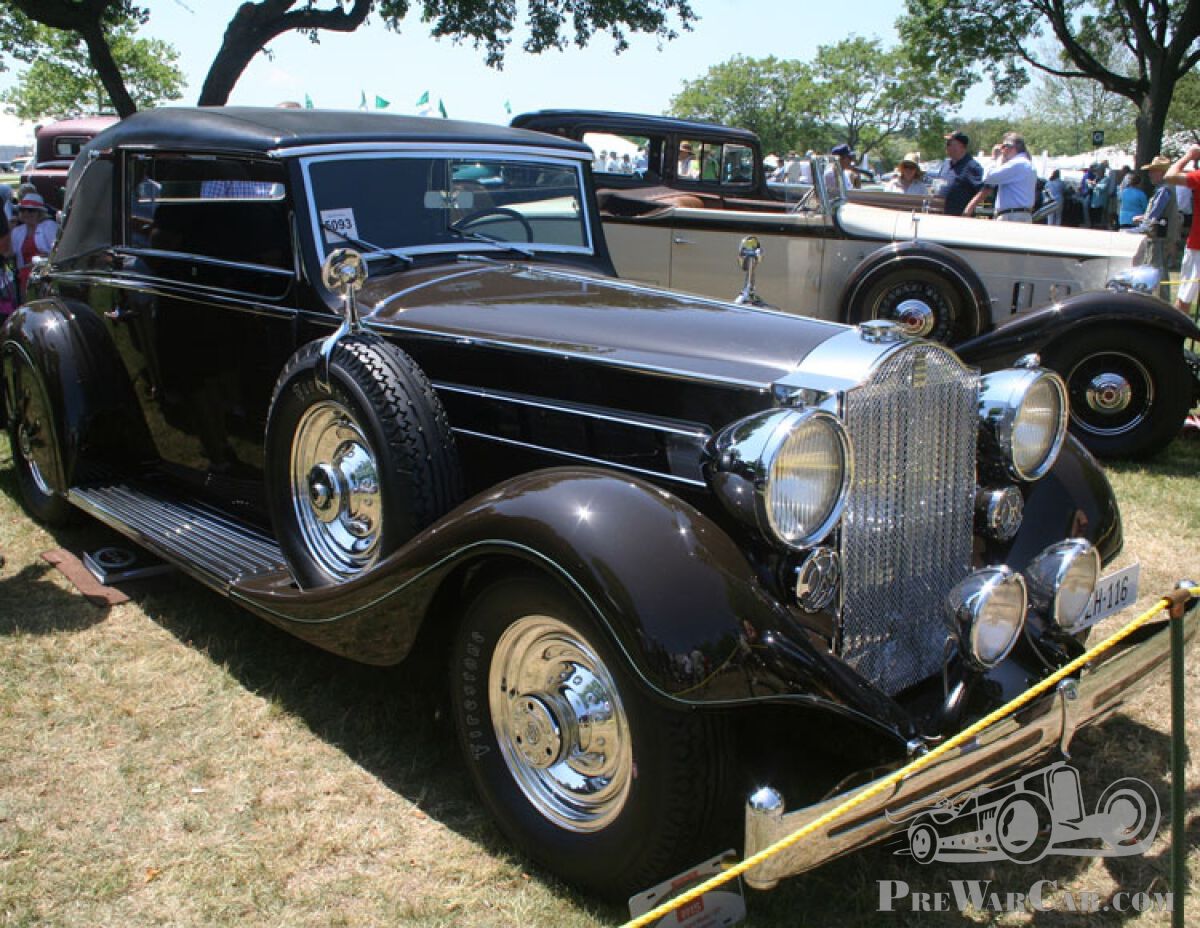


Packards all have an air about them. From first glance, one can usually tell a Packard, if not from its distinctive radiator shape then from its hexagon-adorned hubcaps. What, then, are we supposed to make of this 1935 Packard, which was deemed Best of Show at last Saturday's 20th annual Greenwich Concours d'Elegance in that Connecticut town? Looking perhaps more like a Hispano-Suiza, it carries a body by Hermann Graber of Bern (which the Swiss will tell you is pronounced GRAHber, not GRAYber), and badged profusely under his own name by Werner Risch of Zürich, the Swiss importer and distributor. Even the hubcaps bear the Risch label, replacing the hexagon, and the vee-shaped Packard grille of 1935 is dispensed with, replaced by an earlier flat radiator, itself disguised with a stone screen. Deceptively, it is on the Series 1201, basic Eight chassis, not the Super Eight or Twelve platform. From the Ralph Marano collection in New Jersey, it wowed the judges from its very entry to the field, resulting in the Best of Show honors.
The people, on the other hand, went for familiar beauty. People's Choice was handed down to a 1932 Auburn 8-100A Speedster owned by H. DeWayne Ashmead. Auburn Speedsters look wonderful in any color, even black. Most unusual Classic might be the 1934 Duesenberg of Sonny and Joan Abagnale. Outfitted with supercharged engine and a luggage rack on its Rollston body, it could be the world's fastest stagecoach. The Greenwich Concours d'Elegance, actually two shows in one, reconvened on Sunday with (mostly) postwar European sports cars.
(Text and pictures by Kit Foster)
UPDATE by editor: regarding Peter McGuire's remarks about original 'metallic' fish- scale based paint, read this brief history at the Consumerist
Gepubliceerd:
zaterdag juni 6th, 2015
Facebook
LinkedIn
Twitter
WhatsApp
Email
Copy
Reacties
Onbekend
09 Juni 2015, 03:19
This Packard seems to be modified to look more special than what it really is. Packard made good chassis to put beautiful coachwork on but under the bonnet was nothing more than a big flat head engine. You would think an expensive car should have something better than a slim cut above agricultural. Maybe by the early fifties the public knew this and might be the reason Packard fell off the edge of the Earth
Lees verder
Onbekend
08 Juni 2015, 14:13
I suspect that not many people know that there was a form of Pearlescent paint used in the 20's and 30's, if not before. This was achieved by putting fish-scales into the paint when the coats where applied, usually and, most certainly, in the top-end cars by hand.
I only mention this because, once again, we have 'concours' cars which defy the definition of originality in all respects.
To me it is all like the restoration of Carcassonne as carried out by Viollet-le-Duc, nice, very imaginative, but wrong!
(I call his style 'Early Disneyland', but then I am a cantankerous old ******!).
I know that ther are a few people who know and/or understand how cars were in the past. Sadly, perhaps, their restorations exacting and perfect as they may be do not win concours.
When will they ever learn!
(Perhaps you could have a competition over who originally said this).
Regards Peter.
Lees verder
I only mention this because, once again, we have 'concours' cars which defy the definition of originality in all respects.
To me it is all like the restoration of Carcassonne as carried out by Viollet-le-Duc, nice, very imaginative, but wrong!
(I call his style 'Early Disneyland', but then I am a cantankerous old ******!).
I know that ther are a few people who know and/or understand how cars were in the past. Sadly, perhaps, their restorations exacting and perfect as they may be do not win concours.
When will they ever learn!
(Perhaps you could have a competition over who originally said this).
Regards Peter.
Onbekend
07 Juni 2015, 21:41
The factory where swiss Risch Packards were assembled still exists, it is the "rote Fabrik" (red factory) at Zurich. Today it is used as cultural centre.
Here a picture: https://www.flickr.com/photos/ritsch48/11982933873
Lees verder
Here a picture: https://www.flickr.com/photos/ritsch48/11982933873