Het wereldwijde magazine en verkoopplatform voor liefhebbers van klassieke auto’s, door liefhebbers.
Het wereldwijde magazine en verkoopplatform voor liefhebbers van klassieke auto’s, door liefhebbers.


Filter
Maak een keuze
- Auto's
-
Merk >>
-
Bouwjaar >>
-
-
Categorie >>
- Motorfietsen
- Onderdelen
-
Automerk >>
-
Fabrikant >>
-
Categorie >>
- Fietsen
-
Bouwjaar >>
-
Landen


The 1911 Mercer Toy Tonneau revisited


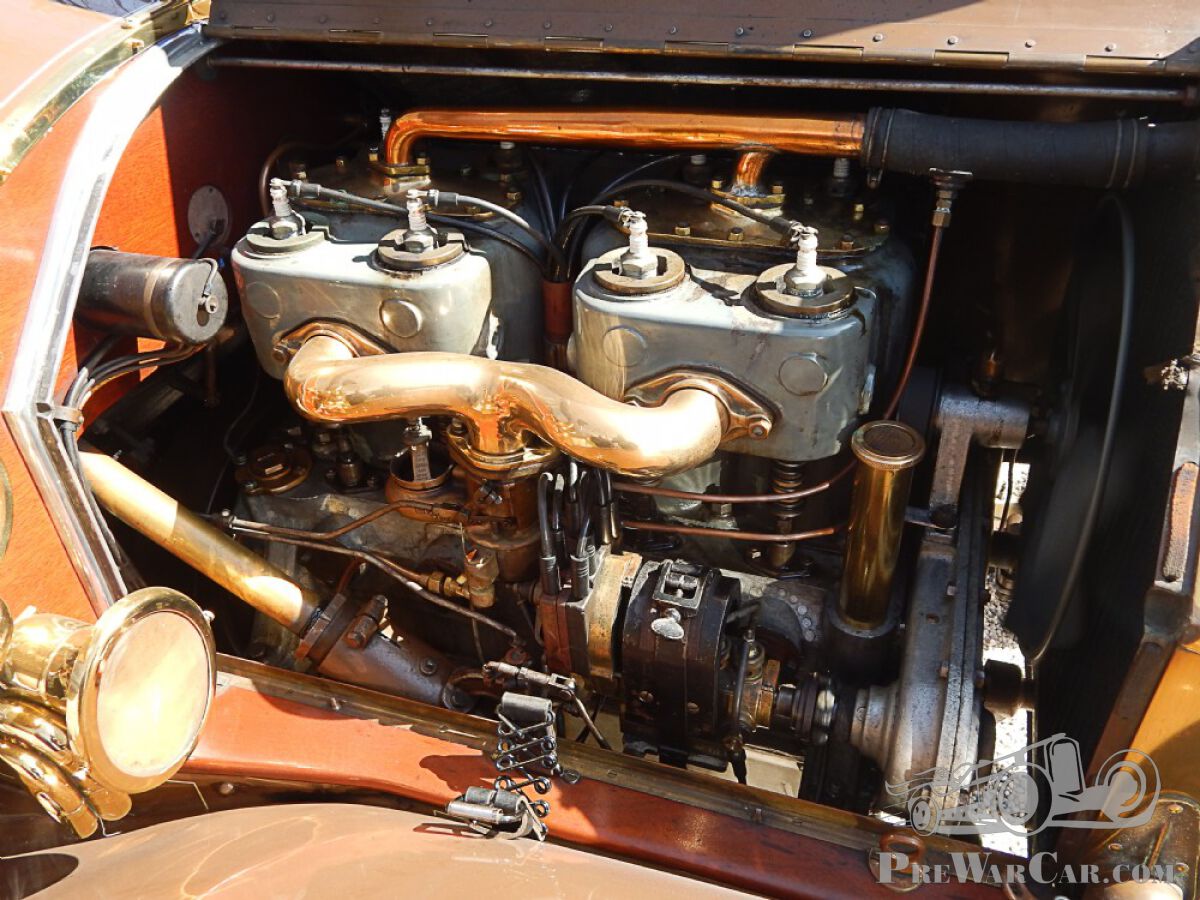


Since publishing our review of the forthcoming Dragone auction last week, we have received some comments which demonstrate the passion with which enthusiasts unravel the history of old cars. The 1911 Mercer Type 35 Toy Tonneau deserves a more close attention. Alan Ballard is a knowledgeable man with a 1911 Mercer catalogue in his collection and believes the Dragone car to be a Type 30M. The catalogue only lists the 35 in 'Raceabout' and 'Runabout' form, but there must have been more. For example, this December 1911 Mercer advertisement shows 4 and 5-seater torpedo bodied cars. We understand that type 30M was the 1910 model designation for the Toy Tonneau with the L-head beaver engine and this car is in fact, according to Austin Clark, a type 35 because of its T-head four cyclinder engine and identical chassis components as in the raceabouts. Mercer originally carried over their advertising from the previous year designating this as a type 30M, but this car is in every way a type 35 and Mercer may not have taken the time to create new advertising for the 1911 model year for the Toy Tonneau. Finally the Standard Catalogue of American Cars (Beverly Rae Kimes/Henry Austin Clark) lists for 1911 the Model 35 Raceabout and Toy Tonneau. So like always there's more under the sun.
Alex Dragone has shared salient facts about engine and wheelbase which satisfy him that his car is indeed the only known Toy Tonneau with Model 35 specification. The other Toy Tonneau known has the much smaller L-head engine. The car pictured above has exactly the same engine as the Raceabout with its Flechter updraft carburetter allowing 200 rpm tick over and 1800 rpm "on occasions when it becomes necessary to obtain maximum speed quickly" (Mercer owner's manual). Ignition is twin-spark Bosch magneto firing on two plugs per cylinder . It is effectively the Raceabout yet with 4 seats and a 6 inches longer wheelbase.
The car was found in 1948 by Henry Austin Clark who said that ‘the Mercer was the finest car produced in America.’ It was the legendary Mercer Raceabout that brought the name to such prominence and at the heart of the car is the legendary 60HP T-head engine. Designed by Finlay Robertson Porter, a self-taught engineer from Ohio, he struck a perfect balance with 300 cubic inches – anything smaller and it would not have achieved the extraordinary racing successes and anything bigger would have sacrificed reliability.
Text Robin Batchelor, pictures courtesy Dragone auctions.
Gepubliceerd:
woensdag april 15th, 2015
Facebook
LinkedIn
Twitter
WhatsApp
Email
Copy
Reacties
Mike Hopkins
14 April 2020, 22:57
I enjoyed this past article very much. I have been researching Mercer’s for over three years and was glad to see the at Ralph Buckley welded the frame back to its original length. I am looking for information on Mercer frames. Did Parrish and Bingham provide frames for the Mercer company? Rear ends? I see that Brown-Lipe May have provided the same in addition to transmissions....some possible connection to American Ball Bearing company or Timken as well. Nothing definitive. Can you provide any leads here? Many thanks, Mike Hopkins, Costa Rica
Lees verder
Onbekend
25 Mei 2015, 16:23
For 1911 the T-Head engines offered were the M and the R with the same 43/8 by 5 bore and stroke, just as John mentioned. The M had dual Bosch and the R had a single Bosch magneto. From 1912 through 1914 the raceabouts and runsbouts continued with the 43/8 bore while all other models were 41/2.
Lees verder
Onbekend
24 Mei 2015, 02:22
The engine in this car is the same as the engine in a Raceabout, but the cars have different rear-end ratios, which is what causes the difference in speed.
Lees verder
Onbekend
22 Mei 2015, 18:20
Not all T-head Mercer engines were the same, Raceabout and Runabout engines were 4 3/8 bore while touring and the rest were 4 1/2 bore, all T-Head 35s were the same stroke. It is said the compression ratios on the raceabout and runabout was higher than the other models.
As for rear end ratios, the raceabout and runabout were 2.52 to 1 up to 1913 and only the raceabout was 2.52 to 1 in in 1914. The touring was 2.82 to 1 and the runabout and touring chassis was 2.82 to 1 in 1914. The rear end ratios, higher compression, and light weight is the reason Mercer's tend to fly.
The toy tonneau shown above is a fine specimen and should do well with its pedigree.
Lees verder
As for rear end ratios, the raceabout and runabout were 2.52 to 1 up to 1913 and only the raceabout was 2.52 to 1 in in 1914. The touring was 2.82 to 1 and the runabout and touring chassis was 2.82 to 1 in 1914. The rear end ratios, higher compression, and light weight is the reason Mercer's tend to fly.
The toy tonneau shown above is a fine specimen and should do well with its pedigree.
Onbekend
22 Mei 2015, 09:07
It is good that my comment has stirred up some discussion on Mercers. Just to get things straight from what Allan Ballard said, is the engine of any model of Mercer in a given year in the same state of tune as well as being the same displacement? Meaning then that the raceabout is faster simply because it is lighter, and does it have the same rear end ratio or are there different ratios? There are none of these here in NZ. The last time I saw one would have been in 1978 at Harrah's Museum, but I will be in the US in September this year and hope to see another one, or more.
Lees verder
Onbekend
21 Mei 2015, 21:35
I know nothing about Mercers, but I think this is Prewarcar at it's absolute best. To read the comments of Alan Ballard, with all that experience, passion and knowledge, is an sheer joy.
Lees verder
Onbekend
21 Mei 2015, 16:52
Alex, you are correct when you say that the chassis has not been shortened. Alan, you are correct when you say that the chassis has been cut. The crime was stopped in the picture you see above, where the chassis was cut in its preparation to be converted, but Ralph Buckley welded it back together in exactly the same spot as it was cut. If you were to look on the inner chassis rails of the car you will find the beads just before the rear spring perches. You cannot see this cut from the outside of the car. Subject settled.
Lees verder
Onbekend
21 Mei 2015, 16:00
Mr. Ballard, Thank you for your knowledgeable opinions about the Mercer toy tonneau. As you say it is a very unique and great example of a Mercer. In regards to the frame allegedly being altered at one time, that is not true as we have analyzed the car thoroughly and there are absolutely no signs of any cuts or alterations. When the car was found by Austin Clark, the owner of the car at that time had taken the tonneau off of the car (as pictured) with plans to cut the frame and make it into a raceabout as most were, but Austin urged Miles Coverdale to buy the car, which he did, and the car was then sent to Ralph Buckley and restored to its original glory. Austin Clark was so proud about saving this car from being turned into a raceabout that he used to speak about it often. I have personally driven this car around since it has arrived for the auction and it is absolutely magnificent. If you are looking for a car to take on a tour in which you can pass modern cars at 70 MPH then this is the car for you. Words cannot express how great of a driving experience this car gives. I enjoy driving this car more than a raceabout and it is more agile and comfortable to drive than a Simplex or Lozier of the same year. Truly one of the greatest brass era cars made in the United States. Mr. Ballard, this car is one of the most original T-head Mercers in existence and is equivalent in significance and originality to your raceabout but only in Toy Tonneau form. You are welcome to come and inspect the car for yourself if you would like, just let me know.
Lees verder
Onbekend
21 Mei 2015, 12:02
Wonderful to see more discussion about Mercer and this unique example. The car in Alex Dragone's auction has a fascinating history. As can be seen from the above picture, the frame has been shortened due to the attempt to convert the car into a raceabout many years ago. Not only was the wheelbase of the toy tonneau longer but it had three-quarter elliptic springs as opposed to the semi-elliptic springs on the raceabout. Thank goodness that the car was sent to Ralph Buckley who restored the car back to its original style and beauty.
As far as the nomenclature is concerned, there are certainly discrepancies in the material published by Mercer and the cars that were produced. Acknowledged Mercer authority Fred Hoch said many years ago that there are many inconsistencies among the cars. In response to Mark Dawber's comment, there was never a difference in T-Head engine displacement between the raceabouts and the other models. I have been around Mercers for over 70 years and I have a considerable amount of Mercer material. I may not be an expert by Mark's definition, but I am fairly knowledgeable about early Mercers. The Austin Clark car sold at the RM auction last year was converted to a raceabout from a runabout by my father's restoration shop back in 1946. In addition, I own the only 1911 raceabout that is documented to have left the factory as a raceabout.
Alex, good luck at your upcoming auction and I hope that the Mercer does well - it is a unique example of this marque.
Lees verder
As far as the nomenclature is concerned, there are certainly discrepancies in the material published by Mercer and the cars that were produced. Acknowledged Mercer authority Fred Hoch said many years ago that there are many inconsistencies among the cars. In response to Mark Dawber's comment, there was never a difference in T-Head engine displacement between the raceabouts and the other models. I have been around Mercers for over 70 years and I have a considerable amount of Mercer material. I may not be an expert by Mark's definition, but I am fairly knowledgeable about early Mercers. The Austin Clark car sold at the RM auction last year was converted to a raceabout from a runabout by my father's restoration shop back in 1946. In addition, I own the only 1911 raceabout that is documented to have left the factory as a raceabout.
Alex, good luck at your upcoming auction and I hope that the Mercer does well - it is a unique example of this marque.
Onbekend
21 Mei 2015, 01:38
It would need confirmation by an expert but I think the engine in the touring Mercers was bigger than the raceabout one. Possibly 50 hp for the raceabout and 60 for the touring cars which were bigger, on a longer wheelbase, and heavier.
Maybe the raceabout engine was limited to 300 cid to fit the racing formula of the time?
Lees verder
Maybe the raceabout engine was limited to 300 cid to fit the racing formula of the time?