Het wereldwijde magazine en verkoopplatform voor liefhebbers van klassieke auto’s, door liefhebbers.
Het wereldwijde magazine en verkoopplatform voor liefhebbers van klassieke auto’s, door liefhebbers.


Filter
Maak een keuze
- Auto's
-
Merk >>
-
Categorie >>
- Motorfietsen
- Onderdelen
-
Automerk >>
-
Fabrikant >>
-
Categorie >>
- Fietsen
-
Bouwjaar >>
-
Landen


The Jiffy Mystery Tool (UPDATE II: MpG tester still in use with Vauxhall in the fifties)
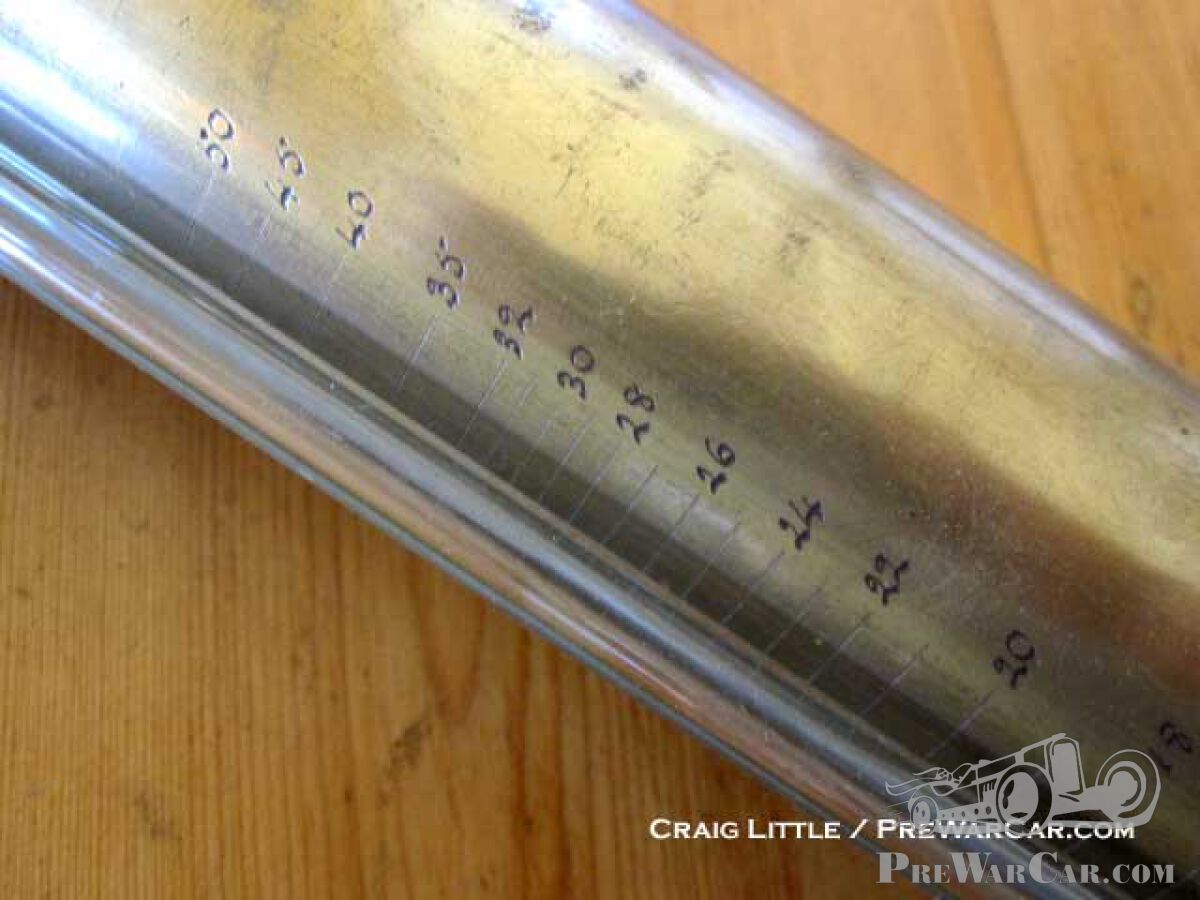




Craig Little from Australia was recently given this vintage device and wonders if someone may be able to explain it's use or purpose. The tool consists of a cylindrical reservoir made from brass and it’s 38 cm high and measures 5 cm in diameter. Attached to the side is a sight glass tube and at the base a tap. The top of the tube is engraved “The Jiffy Tuning and Testing Gauge". At the base level with the bottom of the glass tube it is marked and engraved 8 and at the top it is marked and engraved 50. Oddly the graduations reduce in depth as they rise up the cylinder but at the same time the numbering increases so at the bottom the distance between 8 and 9 is 34 mm whilst at the top, the distance between the numbers 45 to 50 is a mere 5 mm. Perhaps it is a reasonably common period engine testing item, or as it is all hand engraved, could it be a prototype? Who can tell us more?
Gepubliceerd:
woensdag mei 5th, 2010
Facebook
LinkedIn
Twitter
WhatsApp
Email
Copy
Reacties
Onbekend
06 Mei 2010, 07:48
As an apprentice with Vauxhall Motors during the 1950's, I can remember using a similar device to check fuel consumption. It was my job to hold the container full of petrol while in the front passenger seat, and open the tap at a marked point on a flat test road. A run of one mile was made each way at set speeds. I can remember being surprised that a 1957 2.6 litre Vauxhall Cresta could return 60 MPG at a steady 30 MPH. Happy days and cheap gasoline!
Lees verder
Onbekend
06 Mei 2010, 06:27
Maybe it is an cubic inch tester
We use it in the auto sport
Google cubis inch tester
Lees verder
We use it in the auto sport
Google cubis inch tester
Onbekend
06 Mei 2010, 03:31
I would believe it is a Miles per Gallon testing tank. Fill it with gas and run a specific distance. Where the level is at the end of the run is the MPG. Use just a little and read high numbers; use a lot of gas and read the low numbers.
Lees verder
Onbekend
06 Mei 2010, 01:03
Never saw one like this before but I think it is similar to homemade "manometers" I have built early in my life. These were useful to equalize the "draw" of twin or multiple carburettors.
The pet cock would have a hose which would have a suitable disk on it which was to be held against the carburettor intake and the rush of air would create a slight vacuum in the cylinder, which would lift water (in some types a small ball). The markings are a puzzle as they should be equal in spacing (?).
Over the years there have been several carb. balancing devices made commercially and they are a help to some mechanics but I like the old method of using a small hose held into the carb throat and applied to your ear. Differences in the hissing sound are easily heard and perfect balance can be obtained.
Dick Trenk
Lees verder
The pet cock would have a hose which would have a suitable disk on it which was to be held against the carburettor intake and the rush of air would create a slight vacuum in the cylinder, which would lift water (in some types a small ball). The markings are a puzzle as they should be equal in spacing (?).
Over the years there have been several carb. balancing devices made commercially and they are a help to some mechanics but I like the old method of using a small hose held into the carb throat and applied to your ear. Differences in the hissing sound are easily heard and perfect balance can be obtained.
Dick Trenk