Het wereldwijde magazine en verkoopplatform voor liefhebbers van klassieke auto’s, door liefhebbers.
Het wereldwijde magazine en verkoopplatform voor liefhebbers van klassieke auto’s, door liefhebbers.


Filter
Maak een keuze
- Auto's
-
Merk >>
-
Bouwjaar >>
-
-
Categorie >>
- Motorfietsen
- Onderdelen
-
Automerk >>
-
Fabrikant >>
-
Categorie >>
- Fietsen
-
Bouwjaar >>
-
Landen


Tyred tread
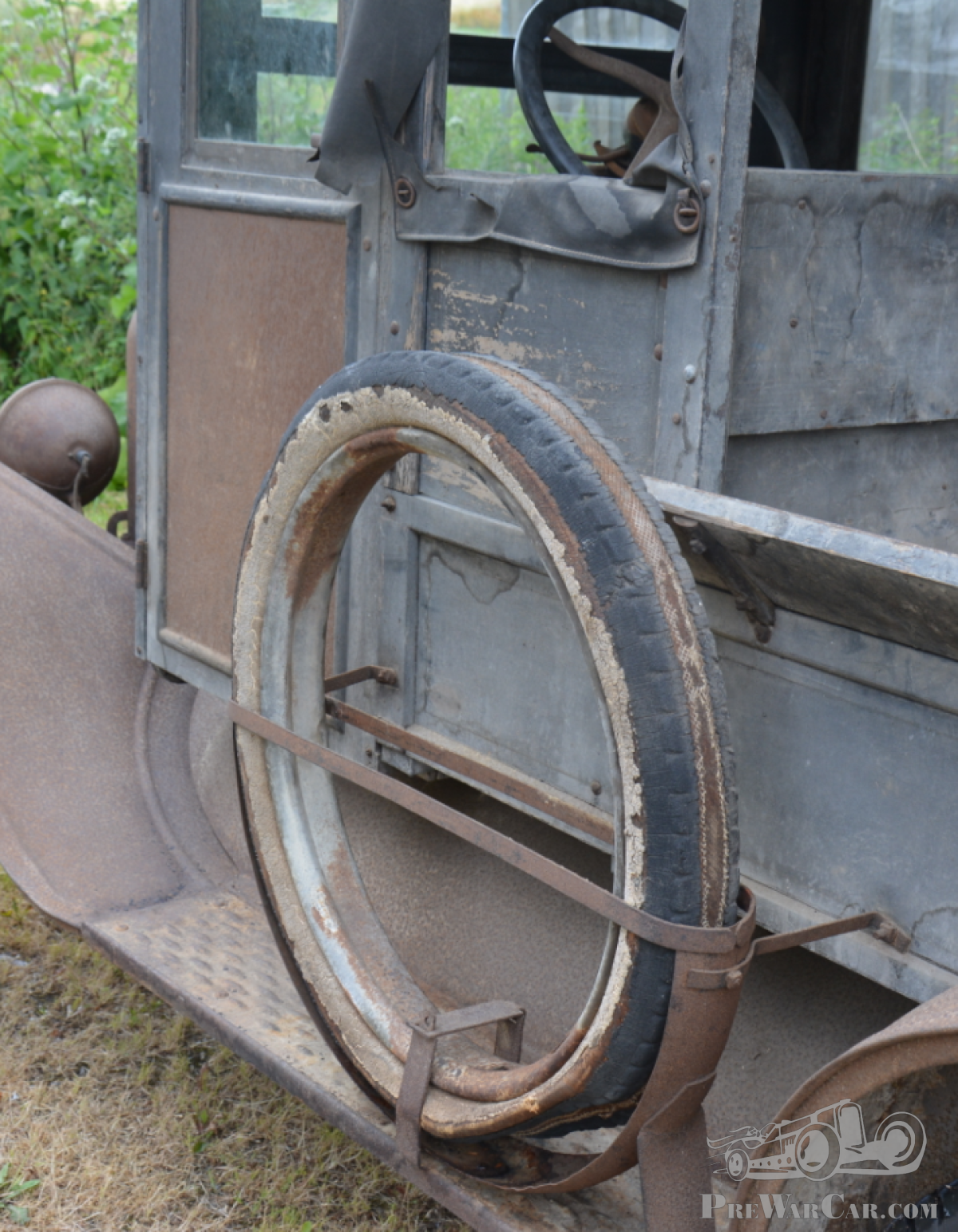


With the MOT test no longer required for many of our cars in Britain, there has been more talk about the state and age of tyres. The experts say tyres should be changed every ten years however good the tread may look. The MOT test was introduced by Ernest Marples in 1960. Before then it was not uncommon to see cars with tyres which had very little tread on them or were even bald. The worst-case scenario was that the rubber had been worn away and the canvas of the tyre exposed underneath. I was reminded of those days by this photograph and background history of a Model T Ford in the USA which had been off the road in a barn since 1944. Rather ironic that this was the spare tyre, but quite usual for an old tyre to be carried as the spare, presumably just to get you home.
It is sometimes difficult to remember how much some things have changed over the years. The Traditional Car Club of Doncaster`s magazine recently reproduced an old advertisement that made me smile. Unfortunately, it was not dated. It was advertising a re-grooving tool priced at 4/6d for re-grooving smooth tyres, and ran “Smooth tyres are illegal. With this simple British made tool you can re-groove almost like new in a few minutes to any pattern. No injury to tyres. Less likelihood of punctures. 5000 safe miles added to tyre life. Quick. Easy. A boy can re-groove perfect non-skids at first attempt.”
I imagine most of us would challenge the majority of claims made! In the light of present-day experiences, regulations and MOT tests it sounds horrifying. I wonder if anyone has a re-grooving tool – one ought to be displayed in a motor museum, just as a reminder.
Words by Michael E. Ware.
Gepubliceerd:
dinsdag juli 14th, 2020
Facebook
LinkedIn
Twitter
WhatsApp
Email
Copy
Reacties
Maldwyn Jones
15 Juli 2020, 12:20
Grimmo
14 Juli 2020, 19:32
DD advertised from 133 Knightwick Cresent, Birmingham in 1939. Home tyre cutters appeared in Britain in the mid to late 1930s and some were still advertised for 4/6 in 1942. You would be a skinflint to use one as garages had advertised on-car electric re-grooving from 1932 using Harvey Frost or Peco machines at only 1/6 per tyre or 4/6 for all four.
There was advice and a caution for the 1939 amateur: “TYRE GROOVING Tyre grooving has become so popular now that cheap gadgets are being sold that the amateur can do his own work and save quite an appreciable amount of money. However, though tyre-grooving is an excellent idea, care must be exercised. Never try to groove a tyre which is obviously almost worn out, because there is always the possibility of the groover cutting clean through the canvas. Grooving is not a procedure intended for badly worn tyres, but a method of improving a partly worn tread and giving it a “bite”. A home tyre-groover is a good investment, but use it with discrimination and not as a means of putting off the purchase of a new tyre till a later date.”
And the kids could use them afterwards to make linocut prints...
Lees verder
There was advice and a caution for the 1939 amateur: “TYRE GROOVING Tyre grooving has become so popular now that cheap gadgets are being sold that the amateur can do his own work and save quite an appreciable amount of money. However, though tyre-grooving is an excellent idea, care must be exercised. Never try to groove a tyre which is obviously almost worn out, because there is always the possibility of the groover cutting clean through the canvas. Grooving is not a procedure intended for badly worn tyres, but a method of improving a partly worn tread and giving it a “bite”. A home tyre-groover is a good investment, but use it with discrimination and not as a means of putting off the purchase of a new tyre till a later date.”
And the kids could use them afterwards to make linocut prints...
Larry A. Lewis
14 Juli 2020, 19:06
I've never heard of re-grooving a tire here in North America but re-treading used to be popular for passenger cars. That has gone away but retreading truck tires is common and they often disintegrate on the highways and leave rubber strips on the road. I once saw a truck tire explode on the highway. It went with a WHOOM and a cloud of gray smoke and rubber was all over the road. It was dangerous to navigate around it without crashing into another car. It happens all the time in Canada.
Lees verder
Graham Smith
14 Juli 2020, 10:01
In the 1950s, being a penurious student, and running a car on a shoestring, I bought a recut tyre for my Austin 10/4 from a garage in Oxford. The price was 10/- (50pence). This, at a time when when petrol was 4/6d per gallon, seemed a bargain. The tyre had a good tread with no canvas showing. Unfortunately, after a run of 20 miles, a bulge the size of a cricket ball appeared in the sidewall. Not a wise investment!
Lees verder
David Scott
14 Juli 2020, 08:27
Certainly in my early motoring in the Sixties they still re-cut commercial truck tyres, I doubt they still do but it was quite common, the tyres were, I think, actually made to be recut.
If you fancy having a go, you can still buy tyre grooving tools from motorsport people as they sometimes groove slicks to make a tyre for very light rain, or they did until recently.
Lees verder
If you fancy having a go, you can still buy tyre grooving tools from motorsport people as they sometimes groove slicks to make a tyre for very light rain, or they did until recently.
Graeme Simpson
14 Juli 2020, 00:47
We drove a 1947 Fiat Topolino in 1960 to 1990 as our everyday second family car. When bought, a couple of the tyres had visible tread, but without depth. A local tyre re-treader gave us the option to re-groove (cheap) or re-tread (not so cheap). We drove on the re-grooved tyres until those grooves almost disappeared, then re-treaded them. I remember that he warned us that 'modern' tyres did not have as much rubber under the tread, so that they could not be re-grooved safely. We had 4 children by 1968, and they could all be shoe-horned into the little car to be driven to school.
Lees verder
Mike Rose
14 Juli 2020, 00:34
When a Model T was everyday transport in post-war colonial daze
we used to reckon on getting 200 miles for each new layer of canvas.
I never did locate the Gilhooley Point.....
Lees verder
we used to reckon on getting 200 miles for each new layer of canvas.
I never did locate the Gilhooley Point.....
As to the so called expert advice to replace tyres that are 10 years old or older. This may be advisable on vehicles that are used regularly and at high speed but not on vehicles that have low annual mileage . Keeping the vehicle indoors out of direct sunlight and on axle stands will greatly reduce tyre sidewall cracking and tread separation.